heartbreak.
Foreword
The act of creating something is easy. The act of creating something good or worthwhile is hard. Who determines when a creation reaches that distinction? Is it the audience who decides when something is worthy of celebration, or is it the creator? What happens if there’s no audience to evaluate the work? Can something be good if it exists solely for its own creator?
This is a post I’ve debated making for several years now. As someone who has run tabletop RPGs for almost a decade, I’ve come to appreciate how much work goes into creating something. The end product is the work of countless hours of effort, which can never be fully appreciated or understood by the recipient. Even to those who go through the same process, every individual’s experience with creating something is unique and speaks to their own ethos and struggles.
This is why I want to approach this topic with a careful hand. The act of creating something is deeply personal, and I do not want to dissuade any fledgling writers who want to try their hand at making their perfect piece. What you may end up with might be ideal for you and nobody else, and that’s okay. However, it is also within the rights of the audience to examine and critique a work in a greater context, outside of the creator’s intent.
This is a post about the Realms of Atlantasia, a tabletop RPG that had zero press, zero critical acclaim, and failed on many levels to be a tolerable RPG. It features confusing mechanics, nonsensical worldbuilding, and a slew of racism and sexism. It is an RPG for nobody but its own creator.
Trigger Warning: The contents of The Realms of Atlantasia contain descriptions of sexual assault, racism, and slurs. Reader discretion is advised.
Introduction

The Realms of Atlantasia is a 2011 tabletop role playing game by John Holland. I was first introduced to the game by a friend who had found references to it on 4chan’s /tg/ board, then proceeded to track down a copy. In the thread, few had heard of the game and it was clear why. The game only had roughly 2500 results on Google at the time, and 99% of them were completely unrelated to the subject, often conflating Atlantis and Atlantasia.
The most coverage the game ever received was /tg/ threads and a few reddit posts making fun of the game and its contents. Comparisons were made to the World of Synnibar, another much maligned tabletop RPG known for its nonsensical worldbuilding and bizarre rules and combat system. Here is a link to a very 2001 review of the game on RPG.net to give an idea of the content. I can’t disagree this game isn’t similar for reasons that will soon become apparent.
Atlantasia consists of a single book, though more were planned before being scrapped. When looking at the Game Master’s Bible, you’ll be met with the following description.
Here is a complete tome! Within these pages is all you will need to run a successful campaign on a brand new world! In here you will meet beings you have never met anywhere else; a new concept of magic-using (8 different Schools of Magic/8 different Temples of Worship), each of which have their own spells; and the most realistic fantasy-based R.P.G. on the market! There will be some constants you have met before (i.e.: goblins, trolls, ogres, etc.), however, even these have a new slant on them! And as stated, the most realistic fantasy-based game around (if you do not get your armor and weapons repaired, you could lose them in the middle of battle; if you do not care for your horse, you could lose it as your horse has Life Points as well). So have fun with this brand new world and the many new being you will meet during your adventures!
The book was self-published through iUniverse, and this blurb was presumably written by John Holland. Keep close attention to the lines about realism, there will be much to discuss about it later.
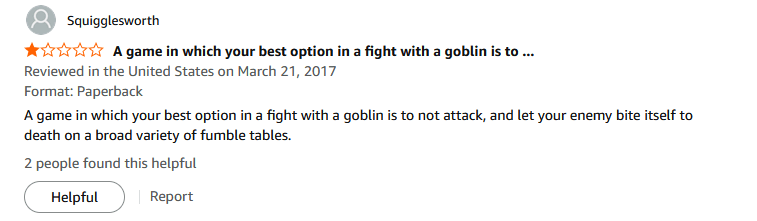
Amazon has one review of the book, which is a dire omen of things to come:
The Atlantasia Website
Before going into the book itself, lets take a detour and look at the Realm of Atlantasia website. Since I originally took the following screenshots, the site has gone permanently down and I am unable to find any working traces of it on the Internet Archive. I’m including this here as its practically lost media at this point and should be documented.

These links are listed within the Game Master’s Bible to get the character sheets. The first one was dead when I accessed it initially in 2020. I was unable to recover anything from it.

The second site on Wix.com was still accessible, but was made entirely in Adobe Flash. I had to install Internet Explorer and an old version of Flash in order for it to work, but the effort did pay off:

Now we’re getting somewhere. Lets begin with the About Us section of the site:
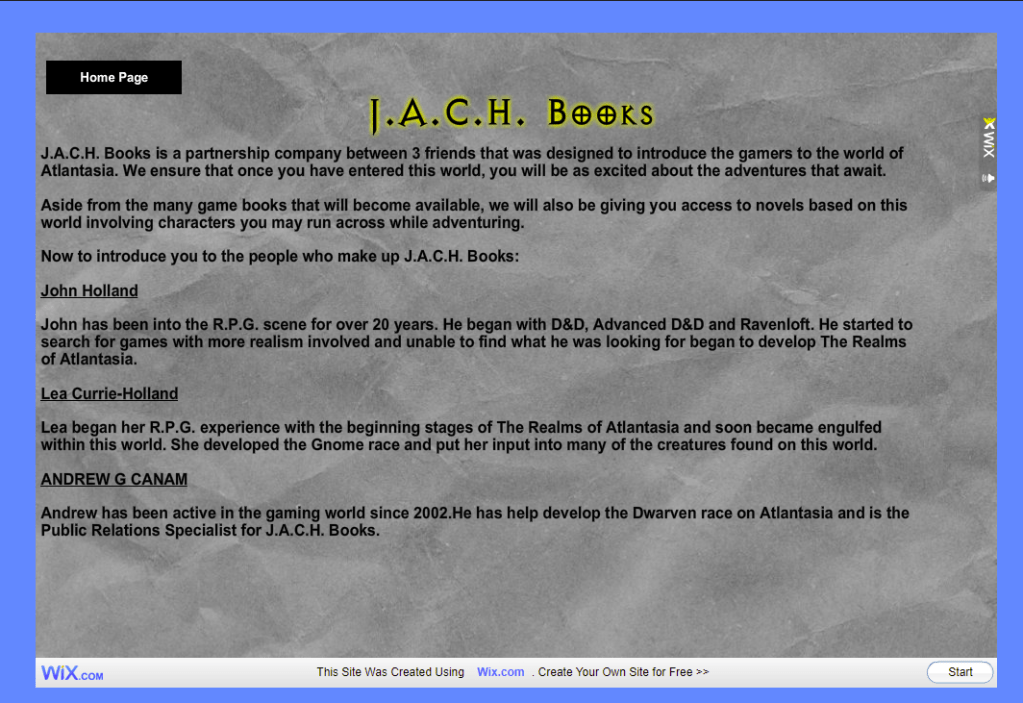
There are three individuals associated with Atlantasia:
- John Holland, who did the majority of writing. Beyond the short description above, there is a short biography on the back of the book:
John Holland gained an interest in fantasy-based R.P.G.s back in the late 1980’s. He soon became dis-enchanted with the game, but not with the concept. From this interest the idea of Atlantasia began forming and he began juggling a career in the Hospitality Industry and designing The Realms of Atlantasia. John lives in rural Alberta with his wife and their three “children”, Mouse (our 12 yr. old Maine-coon kitty), Majyxx (our 1 1/2 yr. old “panda” kitty) and Marxx (our orange striped “gnome” kitty). He keeps busy putting together more books on Atlantasia; including more supplimentary books to the Game Master’s Bible, plus novels of adventures in these realms.- Lea Currie-Holland, who designed the Gnome race and provided input on creatures in the book.
- Andrew G. Canam, who provided support on the Dwarven race.
Their company, J.A.C.H. Books planned to create multiple Atlantasia books, including novels. As previously stated, none of these ever came to fruition beyond the Game Master’s Bible.
Many years ago, there was a short essay on now defunct RPG forum TheForge, where game designer Ron Edwards coined the term “Fantasy Heartbreaker”. The term was shorthand for a game designed by someone with a low exposure to the greater RPG ecosystem, usually only Dungeons & Dragons. Typically these games would originate from the author finding frustration with how D&D plays, or finding its systems lacking, so they went “I’ll make my own, with blackjack and hookers!”. This isn’t uncommon in the RPG sphere, plenty of popular games have been created from this, like Pathfinder coming from 3.5 edition D&D.
These “heartbreakers” would either make a few minor changes, or completely revamp the system into something unrecognizable. The point was that these games would always fail and fall into obscurity, because the author either lacked the mechanical skill and knowledge to write something people would want to play, or was financially insolvent enough to market the game to a real audience (sometimes both!)
I don’t like using this term, as I alluded to the foreword. I think that a great deal of work was put into what exists for Atlantasia. However, I do think there’s some sort of cosmic-level comedy in play here where Atlantasia manages to hit every single quality of the heartbreaker specimen. Holland states his experience was with D&D, AD&D, and Ravenloft. He grew frustrated because the games lacked “realism” in their mechanics, so he went and made his own. Ultimately, Atlantasia was never successful so he was unable to produce any of the other content he planned, leaving it permanently incomplete.
Returning to the website, we move to the Compare Us page:

In honesty, none of these things set Atlantasia apart from other RPGs. Percentile dice are common across a wide variety of games, and fantasy games will often invent their own magical systems and faiths. Things like unique abilities, creatures, careers and specialties, and character advancement are all mainstays of the genre, I’m really not sure what Holland was going for here.
On the topic of realism though, it gets its own page:

It’s at this point I think Holland was starting to get over his head a bit. In RPGs this is usually part of “crunchy” game design, often involving extra math and bookkeeping for players to simulate realistic concepts like weight, hunger, or resources. It’s not wrong to want these things, there are plenty of systems where you can find these features as either core or optional rules. Systems like this can add an extra layer to complexity and strategy for both the players and the GM. Yet there needs to be an understanding of why these systems need to exist, what does the friction add to the game? The vibe I get from Holland’s descriptions is that he wants a high-stakes punishing game, where proper planning and maintenance are necessary to succeed. When we actually delve into the systems and text of the book though, this really comes at odds with what gets presented.
Just adding a few more screenshots of the now unavailable site for posterity:


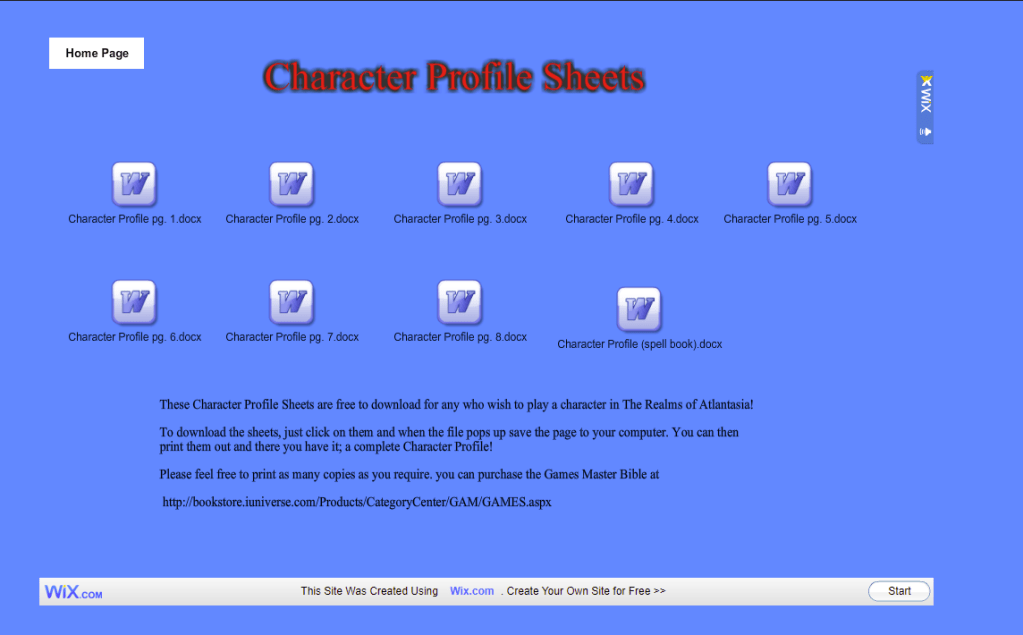
Yes, you are reading that right. Character sheets for the Realms of Atlantasia are 8 to 9 pages long (including the spellbook). Unfortunately these download links were down by the time I got there, so I have no idea what the actual sheets look like. If there are any internet detectives who are able to track down these files, I’d be extremely happy to add them here as an addendum.
The Introduction (Of the Book)
The Realms of Atlantasia begins with a dedication:
I would like to thank the following people for their contributions to this work.
Alisa Currie: for her dedication to this proiject [sic] and the development of the Gnome Race;
Andrew Canam: for his assistance in the development of the Dwarf Race.
I assume Alisa Currie is the same person as Lea Currie-Holland mentioned on the website, since they both claim responsibility for the Gnome race. I’m including the dedication because I want to bring attention to multiple individuals writing the character races. There is a lot of writing about the interactions between the races, and I think this bleeds through a bit.
Welcome travellers and adventurers to the new and wonderful world of Atlantasia; where magic
roams freely and Dragons rule the realms. Here the adventures never seem to quit as your group(s)
traverse the many diverse countries and remarkable cities. You will interact with mythical creatures
of lore as well as running across new and unusual beings that will keep your mind spinning while
you try to figure out their weaknesses. In your travels you will see just about any type of landscape
you can imagine; from raging wintery tundra, to wide open oceans, to searing dry expansive deserts
and everything in between.
Unlike many comparable rulebooks, Atlantasia contains no rules on how to run an adventure. It primarily contains character creation, monsters, items, spells, and rollable tables (oh so many rollable tables).
With magic roaming freely across the lands, one must be careful of who (and what) you encounter
along the way. Unlike other RPG games, in the Realms of Atlantasia the magic are varied and
require a great deal of thought before deciding the School of Magic or Temple of Worship you wish
to take on as a career; for each has its own pros and cons. Each School of Magic and Temple of
Worship has its own spells and double classing in these fields is very difficult, to say the least, and
not recommended for the novice player (double classing is also extremely limited when magic using
is involved).
The Guild Classes (Thieves, Assassins and Spies) gives the player a chance to see how the other side lives. However, you must be careful as there are rules that MUST be followed and has dire
consequences if these rules are breached. These classes are the best for double classing (along with
the Fighter Classes) and a character can come up with many interesting combinations to enhance
their game.
This description is not wrong, the magic system is very involved but in a really confusing and meandering way. Double (and triple!) classing is a key element of Atlantasia, which gets bogged down by that mention of rules that “MUST be followed”. Imagine the most obnoxious player at your table going “But its what my character would do!” and being unable to stop them because its literally written in the rules that they must do it. The same is true of the Schools of Magic and Temples of worship, believe me we’ll get there.
The Fighter Classes are the “bread and butter” of RPG games and it is the same on Atlantasia. They
will be the backbone of many groups, keeping the rest as safe as possible. A few of the Fighter
Classes are intricately intermeshed with other classes (most notably Champions with the Temples of
Worship and Foresters with Druids). While the Fighter Classes will have an easier time with many of
the encounters along the way, they will run across creatures that are best dealt with through magic
and thus will have major difficulties (especially without the proper armor and weapons) in
dispatching these opponents. This will (or should) keep these fighters from rushing into ea ch and
every encounter.
I don’t really have much to say about the fighter description, its very generic. I just think its really funny how Forester is a class, which is quite literally just a lumberjack.
The Miscellaneous Classes (Bards, Gypsies and Nobles) gives players even more opportunity to
enhance their gaming experience. Each class has their own advantages as well as diverse abilities.
These classes are able to be double classed rather easily, however, players will have to be careful as
to which class they take as a second as this could limit their ability to perform their first class duties
(ie: Bards and Assassins do not mix very well as Assassins prefer the shadows where a s Bards must
be in the spotlight in order to perform).
There are four groupings of classes: Magic, Guild, Fighter, and Miscellaneous. The book does not do a particularly good job of explaining why each class fits into a specific category. As far as I can tell, Guild classes are supposed to be “evil” for lack of a better term. They are designed to allow players to take morally dubious actions without the need for characterization beyond what’s in the class description. Miscellaneous is a catchall for anything that doesn’t fit in the other broad categories. And yes, Gypsy is a playable class. This was written well after the term fell out of popular use and into slur territory. I have an inkling about why this is here, but it requires some later context.
This is just a small bit of what the Realms of Atlantasia is all about. As you peruse the rest of these
pages, each of the character classes will unfold to complete descriptions explaining how each
character should be played. You will learn about the different races (each has its advantages and
disadvantages), the locations that these races reside and how these races relate to the other races
(character classes also relate to other classes differently). So, whether you are a Game Master or
Player, it is advised that you read these pages carefully as they give you clues to how things work on
Atlantasia and through this knowledge lies the best path to take to give you the best possible gaming experience on this world. Happy travelling my friends and may we meet somewhere within these realms!
I will be reading these pages carefully (so you don’t have to) but before we dive deeper, I want to provide a few tidbits I haven’t mentioned up until this point.
- The Realms of Atlantasia is 545 pages. This is a lot for a Game Master’s Bible. There are elements of what would commonly go into a PHB, DMG, and Monster Manual here in D&D terms, but its all in one book.
- The book has no illustrations. Beyond the dragon on the cover, the rest of the book is completely plain text with awkwardly formatted paragraphs and tables. This blog post may end up being more organized than the book itself.
- Third, and most importantly, The Realms of Atlantasia is unfinished. There are references to books never written and stories never told. This makes Atlantasia both hard to play and fully grasp.
Without further ado, lets dive into the Realms of Atlantasia and how it actually works.
Atlantasia’s Races
To create a character, you must select a race. Atlantasia has four races to choose: Human, Elf, Dwarf, and Gnome. Much like any traditional tabletop RPG, these races confer a variety of bonuses to your character, but also inform how you interact with the other Atlantasian races.
Human
Humans are the most diverse race on Atlantasia and can be any class they choose (within the
limitations of that class). Humans live everywhere on Atlantasia, thus giving the player the option of
being from anywhere. They may be able to be anything they want, however, due to the fact that they
have the shortest life span of all the races humans have a difficult time reaching the levels of
expertise in their chosen careers that the other longer-living races can. For this reason
humans tend to be more rash than the other races, rushing around trying to gain as much experience
as they can in as short a period of time as possible.
Humans have as much diversity in looks as Earth does (tall, short, thin, squat) and depending on
where they are from will determine their hair and eye color (see descriptions in the write-up on
nations in the Atlases). Their nationality will also determine what their opinions on other classes and
races will be (ie: Parnishians will kill Necromancers on sight).
Here is a look into how the other races view Humans:
Elves
Elves see humans as a pest (“Pugrah” is elvish for human) and only barely tolerate their existence.
Dwarves
Dwarves tolerate humans better than elves, but only because humans will buy dwarven made armor
and weapons at a very exaggerated rate (5 times the amount that an elf would).
Gnomes
Gnomes view humans the same way they view every race, a new experience.
Humans are pretty much the same as humans in any other fantasy media: Short lifespans, can take on any class, and have a wide variety of appearances and ethnicities. Unique to Atlantasia, each race has a section on how the other races view them. These range from curiosity to extreme racism. There’s more information on the human cultures in the Atlases, but those were never actually written or published so this is all we get.
Elves
Elves come in many flavors, you get: Sun Elves, Moon Elves, Forest Elves, Prairie Elves, Sea Elves, Mountain Elves, and Shai Elves. So many elves!
Elves are the “fair race” of Atlantasia, known worldwide for their art, their fine features and their
snobbish attitudes (Elves see themselves as above all races; except Dragons, of course). Elves are small in stature (5′ – 5’6”) and it is extremely rare to find an overweight elf. They are the longest lived of the races (except Dragons) ranging from 1,000 to 5,000 rebirths. The Elven Nation exists in Nor-Scand, on the continent of Cey-Bra-Lah (there is a nation of elves in the Eastern Lands called Shai-Scand). On Atlantasia you will NEVER find a half-breed elf (if a female elf was ever raped by another race she would commit suicide). There are 7 types of Elf and each will determine what your career will be.
Yuck. Yeah, this is why I had to include a trigger warning at the start of this. It says a lot about the author to include something like this, but you probably already got the vibe when I called out the Gypsy class earlier. Many RPG settings have Elves be pretentious and vain, but Atlantasia takes it a step further. I don’t want to waste more brainpower on this awful paragraph, lets look at the subraces:
Sun Elves:
These are the noblest of all elves. It is this type of elf that the Royal Family; as well as the High
Council Families; come from. In the military the Sun Elves are the officers (no lower ranking than
Captain who is a commander of his/her own army). Since every Sun Elf is a noble, any character
playing one would have to double class as a noble. However to become a Sun Elf a player must first
roll a Social Status roll for nobility.
Here is a list of careers for a Sun Elf:
- Knight (this is the only career for any within the top 10 houses)
- Champion (only if parents belong to the Priesthood) (lose noble status)
- Priesthood (only if parents belong to the Priesthood) (lose noble status)
- Mage (lose noble status)
- Spy (but do not let this be known among the other noble houses)
It’s strange how they start with this option, because to even play a Sun Elf you have to decide “I am playing an Elf” then make a Social Status roll to determine if you’re “noble” enough to be a Sun Elf. I’m gonna level with you, I don’t understand how this mechanically works, you’re rolling before you even have stats defined? Anyways, you’re locked into specific races based on your subrace for Elves… except 3/5 of them require you to lose your noble status to take, and one of them requires you to lie in game.
I’m not going to post the description for Moon Elves, but they’re extremely bland. They are in the army or magic school, and some are priests. They can be Warrior, Champion, Priesthood (plural?), Mage, Bard, or Spy.
Forest Elves:
Forest Elves are creatures of the woods. They will become the druids and the foresters of the Elven
Nation. These are the only careers for a Forest Elf (may be a Champion of a Grove but must start as
a druid). Forest elves could also become bards.
For a game about realism, it sure likes to push racial determinism. If you are a Forest Elf you must be a Druid or Forester. Unless you want to be a bard I guess.
Prairie Elves:
Prairie Elves are the farmers of the Elven Nation and therefore have limited education and funds.
They still see themselves as far superior to the other races.
Ah, the poverty elves. They have a few basic classes with no restrictions.
Sea Elves:
Sea Elves are the navy of the Elven Military (upper class Sea Elves) and the fishermen/sailors of the
elves. Therefore the only career for a Sea Elf is a sailor, pirate (sailor/thief) or a spy.
This description is wild to me, not because of the race but because of the classes. It just throws out that Pirate is an official designation for a sailor/thief dual class. This is the only multiclass in the book with an official name, no other combination is named and pirate is never again mentioned in the text.
Mountain Elves:
Mountain Elves could have been any type of elf before they were disgraced (or disgraced their family <Sun or Moon Elves>) and fled to the mountains of Nor-Scand and now make their living as a thief. Therefore any playing a Mountain Elf must double class as a thief (cannot be a mage or priesthood).
So Mountain Elves is a racist term for disgraced Elves who are culturally ostracized? But also they are genetically predisposed to all be thieves and can never practice magic? …right.
Shai Elves:
These are the evil elves who were driven from Nor-Scand and escaped to the Eastern Lands. They
established a nation called Shai-Scand and have all vowed vengeance on the rest of the Elven
Kingdom.
Here is a list of careers for a Shai Elf:
- Warrior
- Champion
- Priesthood
- Mage
- Bard
- Spy
- Thief
- Assassin
** For physical descriptions please see the write-up on Nor-Scand in “Atlantasia: An Atlas of the
World”
If you asked me before reading this paragraph who I thought the author intended to be the “evil” Elves, I would have answered the Mountain Elves. But no, there is a dedicated evil subrace for the Elves. Also, we get our first supplement name! “Atlantasia: An Atlas of the World”.
All elves have specific innate abilities. These are:
- infra-red vision 60′
- Immune to sleep/charm spells 100%
- Move silently +10%
- To hit (bow only) +10%
Darkvision? Nah, that’s weak shit. These Elves can see 60ft in infra-red.
Here is how the other races view elves:
Dwarves
Dwarves tolerate elves for the enchantments they put on dwarven-made weapons and armor.
Alliances between dwarves and elves are shaky at best.
Gnomes
Gnomes are fascinated with elves because elves live so long and therefore must have been on many
an adventure.
Humans
Humans put up with an elf’s attitude to try and regain a formidable ally the human race lost when
they forced the elves from most of their lands in the Elven Wars.
I guess that explains why the Elves are so racist towards Humans?
Dwarves
Dwarves are the short (4′ – 4’6″), fierce clans people who rely on expert mining and armorers to
sustain their people. Most dwarves live deep in any one of the mountain ranges on Atlantasia. Each
clan has claim to a mountain range (ie: The Dragonspine Clan lives in the Dragonspine Mountains
on Cey-Bra-Lah). Dwarves make excellent warriors for they are tenacious fighters. Dwarves will live
between 200 – 500 rebirths.
Here is a list of careers for dwarves:
- Warrior
- Priesthood (Shaman only)
- Bard
- Spy
- Assassin (evil only)
All dwarves have specific innate abilities. These are:
- Infra-red vision 120′
- Immune to sleep/charm spells 75%
- Know the value of a gem/jewel 75%
- Know a metal 100%
- Manipulate non-magical metal 60%
So unlike the Elves, the Dwarves are closer to Humans. They get no subraces, only clans, though they are still limited to certain classes. Also they know how to know things about gems/jewels/metals.
Here is how the other races view dwarves:
Gnomes
Gnomes are always trying to learn what dwarves know and therefore will try to latch on to a dwarf
(which usually drives the dwarf crazy).
Humans
Humans admire dwarves for their craftsmanship and seek out dwarf smithies to create weapons and
armor.
Elves
Elves use dwarves for their weapons and armor while keeping up the facade of an alliance made
centuries before.
You might have picked up on the Gnomes being fond of everyone from the previous racial viewpoint sections. The other races seem less fond of them, I wonder why?
Gnomes
Before I talk about the Gnomes, I want to briefly talk about another race: the Kender.
Kender are small humanoids from D&D’s Krynn setting. They look like children with pointed ears, and are a general nuisance. For one, they do not understand the concept of fear, they will charge into any situation and get themselves into trouble at a moment’s notice. More importantly, they have no concept of personal property. They will steal from anyone they get in contact with, including allies. They will take things and never tell anyone they have them, and they have a fascination with breaking into locked rooms and chests.
Naturally, Kender are one of the most hated races in all of tabletop gaming. The kind of player who wants to play a Kender is the most annoying person at the table, who wants to cause havoc and place any blame for their actions on their character. GM’s despise Kender, players despise Kender.
It is with a heavy heart that I say that Atlantasia’s Gnomes may be worse than Kender.
Gnomes are natural born thieves (though it is an insult to a gnome if you call him/her a thief). They
are the smallest of Atlantasia’s races (3’6” – 4′) but make up for it in quickness and courage. Many
gnomes do become thieves because many Thieve’s Guilds make a lot of money with gnomes
on their staff and actively recruit gnomes to join (and it is something that comes naturally to the
gnome). Gnomes also make ideal fighters as well, for a gnome fears nothing (everything is a new
adventure). There are four types of gnomes; Northern Gnome (Charleera/Cey-Bra-Lah), Southern
Gnome (Bowaana/Friss-ahl-likka), Western Gnomes (Tez-lah/Cey-Bra-Lah) and Eastern Gnomes
(Hai-wiy/Eastern Lands). All gnomes are nomadic by nature (always looking for the next adventure
and they are bored easily) and think of all gnomes as being related, in some form or the other.
Gnomes usually live to be about 300 rebirths old.
*Note: please note that all gnome’s names will end in “rull”
Much like the Kender, the Gnomes don’t know what fear is. They’re easily bored and are all thieves by nature. Also apparently their names must end will “rull”. I don’t know why this is. They have the standard classes, but the book specifically says they are bad Spies because they “talk too much”. Notice that bit about being insulted by being called thieves? The next section has some important info:
All gnomes have specific innate abilities. These are:
- Empathy 85%
- Green thumb 15% base (1% per level)
- Map Reading 25% base (8% every 5 levels)
- Chance for item to appear in pouch (in a crowd) 45%*
Chance for an item to appear in pouch, you say?
*This is magical! Gnomes do not actually take things from people they pass, things magically
transfer into a gnome’s pouch (unless people are actually keeping a close eye on their things as a
gnome passes by) and for this reason, other races perceive gnomes as outright thieves. If someone
catches a gnome with something that is theirs, they will immediately give it back with a “Don’t know
how that gots there but must be yers cause ya can describe it”. The only things that appear are small
(coin, gems/jewels, rings & small items). Use this chart for items appearing (and then use start up
chart):
01 – 10%: copper chips
11%: jewel
12 – 21%: silver chips
22%: ring
23 – 43%: copper chips
44%: item (must be small)
45 – 50%: gold chips
51 – 54%: platinum chips
55%: ring
56 – 70%: copper chips
71 – 80%: silver chips
81 – 87%: gold chips
88%: item (must be small)
89 – 92%: platinum chips
93 – 99%: gems
100%: 1 ring, 1 item, gold chips, 1-2 platinum chips
So the Gnomes are just magical magnets designed to steal random valuables from both their allies and strangers, great. Unlike the Kender, this is entirely random, the Gnomes will just steal from others because their racial feature says they do it.
The Humans and Dwarves relation sections are what you expect, they don’t really like gnomes but tolerate them. The Elves one worth mentioning:
Elves seem to have a soft spot for gnomes (maybe because they remember being persecuted) but
will ALWAYS keep an eye (or two) on a nearby gnome. Some elves seem to invite gnomes into a
mixed race group just to get under the skins of the others in the group (especially humans).
Man the Elves are just the worst, huh.
And those are the races! You have Humans, Dwarves, Gnomes, and 7 types of Elves to pick from!
There’s a handy chart showing which races can be which classes, which mysteriously includes classes not mentioned in the race descriptions?

There’s also another table which shows which class combinations are valid…. oh…. oh no.

Good luck deciphering that.
Character Creation
I can best describe character creation as the following steps:
- You have two kinds of stats: Outer and Inner
- Outer stats are Strength, Intelligence, Wisdom, Dexterity, Charisma, and Psychic Strength
- Inner stats are Constitution, Mental Quickness, Mental Retention, Agility, Magnetism(?), and Psychic Defense
- You roll 3d10 for each of your Outer stats, picking the highest roll for each one. You roll 2d10 for each of your Inner stats, once again taking the highest.
- Each race has attribute adjustments (except human) add or subtract from each score as necessary.
- Each class has attribute adjustments, add/subtract as necessary.
- Also, every class has bonus percentage bonuses or minus percentage bonuses for something called “magical stuff”. I’m not joking. Warriors have a +35% for armor on magical stuff rolls, and a -40% for ring on magical stuff rolls.
- If you later pick a second class, you don’t gain any attribute bonuses.
- Each attribute has a bonus based on your final score. For example, you do more damage if you have a high strength. These are fairly boring so I’m not gonna list them here.
- Pick your age! This is different for each race and gives positive or negative bonuses. Why we’re calculating this now after we already calculated our attribute bonuses is beyond me.
- You now roll a percentage die to pick your Social Status. This gives you a negative or bonus to finance rolls and magical stuff rolls. If you’re a street urchin, you get -40% finance and -40% magical stuff. If you’re Royalty you get +50% to finance and +40% to magical stuff.
Got all that? Well now its time to randomly roll for your birthday!
To keep track of how your character is aging you must establish a day of birth. This is done by rolls
of the dice and rolled in stages.
The first stage is to roll for the season you were born in (this is extremely important for some classes
of mage). The next step is to figure out what 1/4 of the season you were born in followed by
discovering the exact day.
There are 5 seasons in 1 rebirth (year). These are (followed by the number of cycles per season):
Season of Air: 80 cycles
Season of Fire: 80 cycles
Season of Water: 80 cycles
Season of Earth: 80 cycles
Season of Chaos: 40 cycles
Here is how a cycle breaks down:
1 semi-segment (s.s.) = 1 round of engagement
10 semi-segments = 1 segment
20 segments = 1 cycle
Start with a percentile dice roll to determine the season and then which 1/4 of the season (1-22%:
Air; 23-44%: Fire; 45-66%: Water; 67-88%: Earth; 89-100%: Chaos)
Next roll a d20 to determine the day (d10 if in Chaos)
This is extremely important for some classes of mage. I don’t think I’ve ever seen a system of timekeeping so strange as this. Lets do some napkin math.
The book never defines how long a round of engagement is, I’m going to be generous and assume a minute which is how long it is in AD&D (in basic edition it was only 10 seconds!). So if a round is 1 minute, 1 segment is 10 minutes. 20 segments is a cycle, which is 200 minutes. The year consists of five seasons, but one of them only lasts half the time as the others. 360 cycles is equal to 72000 minutes, which is 1200 hours. That’s right, a single Earth year is equivalent to 7.3 years in Atlantasia!
The next step in character creation is rolling for finances. There are individual rollable tables for Platinum, Gold, Silver, Copper, Gems, and Jewels. Then you have to roll Magical Stuff for Weapons, Armor, Rings, and Items. These all take into account the finance and magical stuff values you rolled earlier, so you could potentially start with an absolute fortune and powerful magical items, or next to nothing.
There’s a special rule here involving Jewels:
There is a note on jewels that should be recognized. Any jewel with a value of 1000 G.C. or more
has a 1% chance of being enchanted. To discover the enchantment, use the following formula:
first: look at the value/enchantment chart
second: roll to find out if it is a mage spell or a priest spell
third: roll 1d8 to discover the school/temple the enchantment originates from
fourth: roll to discover the spell (1d20/mageling spells; 1d6 -1/level 1 – 5 spells)
There are then tables for spell levels and costs of every school to have a Jewel inscribed. The schools are Air, Fire, Water, Earth, Illusions, Death, the Cosmos, and Elven Mysteries.
The School of Eleven Mysteries has a special asterisk on it:
Note: This is just the base price. It is further adjusted as follows:
Humans: x3 (x10 if you have insulted the Elves in any way or form)
Dwarves: x1 + 1/2 value in Tragonite
Gnomes: x2 (x1/2 if the Gnome has an item the Elf wants)
Elves: the price depends on your type of Elf and varies as follows:
Sun Elf: free with the promise of some favor from the family at a later date
Moon Elf: x1/4 with a promise of some future favor
Forest Elf: x1/2
Prairie Elf: x1/2
Sea Elf: x1/2 with a promise of some future favor
Mountain Elf: x20
Ah perfect, the system accounts for racist pricing options. Better hope you rolled a Sun Elf!
There’s also pricing for the temples of the following deities: Dannuih, Helio, Heliona, Ta-Khu, Khe-Ta, Khiet-Sheen, Philaeia. There’s also the Brotherhood of the Shaman, but good luck getting a Jewel enchanted by them because “A Shaman will ONLY enchant a jewel at the request of the Chief of his tribe and no one else!”
Did you think we’re done with Character Creation? No way, we still have plenty to do. Next you get to roll on percentage tables for your class to determine what talents you get. These are all just miscellaneous percentage bonuses to certain rolls. For example:
Barbarian
01 – 25%: defender (+40% to defense rolls)
26 – 50%: hunter (+20% to precision rolls when using a bow )
51 – 75%: mauler (+30% to precision rolls when in melee rounds )
76 – 100%: swordmaster (+20% to precision rolls when using a sword)
Exciting stuff. Also, Priesthood doesn’t get any talents for some reason.
Then you get to calculate your resistances. Everyone gets a base 10% resistance to magic associated with their deity’s temple. Remember when you picked your deity already? Turns out the book doesn’t have rules for picking a deity, guess you don’t get any resistance then huh.
Some races get resistance to certain magic types, like Dwarves who get 20% (1/2 to Earth magic, 1/2 to Dannuih’s magic). Why not write this as 10% for both?
There are also inexplicably resistances to fire, electricity, heat, cold, and undead. Its important to note that resistances can never naturally increase, you have to specifically find items that give you increased resistances.
Quick! Figure out what your dominant hand is!
To begin one must find their dominant hand (or if they are ambidextrous). To do this the player
rolls % dice once. If they roll 100% they are ambidextrous. If not, they roll % dice 2 more times
(once with their right hand, once with their left hand). These percentage numbers are listed on the
first page under R.H. & L.H.
You then get to figure out your base chance to hit. For Strength this is 20% at 10 points, with an additional 2% per point above that. For Dexterity, this is 10% at 10 points, with similar scaling. As you level up you get more base accuracy, 1% between levels 2 and 10, and 2% between 11 and 20. Your chance to hit is also increased by the weapon you’re using.
You then get to figure out your defense. For Agility this is 20% at 10 points, with an additional 2% per point above that. For Mental Quickness, this is 10% at 10 points, with similar scaling. As you level up you get more base accuracy, 1% between levels 2 and 10, and 2% between 11 and 20. Your chance to hit is also increased by the armor you’re using.
Notice how I just copied the same paragraph and just swapped out a few key words? Don’t worry, that’s what the book did too.
Calculating Magic
I’m putting magic in its own section because it annoys me so much. Spells (or weaves (no seriously, the book puts (or weaves) in parenthesis after spells every time it says it)), cost magic source points. A character rolls 3d6 for their starting points, with bonuses based on psychic strength and constitution. For some reason, if you have a constitution higher than 10, you get a bonus to your starting points of 1/2. Why would you ever need half a spell point?
Your magic source points increase with every level, with the following ranges:
levelling up between level 2 – 10: 1d6 every level
levelling up between level 11 – 20: 1d6 +2 every level
levelling up between level 21 – 50: 2d6 every level
levelling up between level 51 – 75: 2d6 +3 every level
levelling up between level 76 – 100: 3d6
Wait… isn’t 20 the level cap? The hit chance and defense paragraphs stop at level 20, why can you level up to 100 for magic?
Next you roll 1d4 to figure out how many spells you can remember each day. This scales off your Retention and Mental Quickness, and if you guessed that you’d get some funky numbers off Mental Quickness, you’d be right! Every attribute point over 10 gives you 1/3 of a spell remembered. What kind of horrible caster are you to only memorize 1/3 of a spell?
Good news, at least you’re not a Priesthood. Even though they can memorize up to maximum of 12 spells (other casters get 20), you can only use spells granted to you by a deity for a cycle. This can be any number your GM chooses, so theoretically a cruel GM could decide your poor Priesthood gets no spells.
We’ll get further into magic later on, in more detail.
Closing out Character Creation
You’ll finally roll your life total, and then finish up by getting your languages:
All character will begin knowing Common. Check with the language bonus to discover how many
other languages you can learn. In order to learn other languages one must find a being who knows
that language and have them teach you which will take 1 season to learn. Each race will also know
their own language (ie: elves will know High Elvish, dwarves will know Dwarven and gnomes will
know Gnomish). There are a few who will have been taught certain other languages as well. These
are:
Sun Elves: will know Dwarven and Gnomish
Moon Elves: will also know Dwarven
Elven Magi: will also know Chaos Dragon
Earth Magi: will also know Earth Dragon
Air Magi: will also know Air Dragon
Fire Magi: will also know Fire Dragon
Water Magi: will also know Water Dragon
Necromancers: will also know Shadow Dragon
Illusionists: will also know Chaos Dragon
Cosmic Magi: will also know Light Dragon
Thieves: will also know Thieves Cant (sign language)
Bards: will also know Bardic Tongue
*Note: this all depends on whether you can learn any other languages
If there is anything Atlantasia is lacking in, it certainly isn’t Elves and Dragons. Also, for some reason Holland decided that Thieves Cant and Sign Language are the same thing.
Lets Go Shopping!
I can’t believe we’re only 31 pages into this book. Remember, there’s 545 pages of this thing. It should start speeding up once we hit the bestiary and magic spells, because I only want to pick out the ones that are either massively flawed or problematic.
Anyways, the next section is on shops. In Atlantasia, every shop of a type has the same inventory, unless it chooses to specialize. There’s not too much of interest besides some herbs that have a variety of effects like “deadens mind” and “adrenalin boost” [sic]. There’s also a preview of spells available for sale at the various magic schools. Turns out there’s a School of Dimensions that was omitted completely in the last section, neat?
This section is a fun preview of spells found later in the book. You have your common stuff like Flight, Turn Dead, Invisibility, and so on. There are a few ones of note like “Posse (5-10 lv. 5 warriors)” which just lets you summon some burly dudes. I think my favorite is for sale at the Bards. At the low low price of 4500 gold, you can purchase a scroll of Shame, which has the description “Shame (causes everyone in 1 room to pay 1000 G.C. each)”. I’m sure that won’t cause any issues.
Something I have neglected to mention is that the worldbuilding of Atlantasia is deranged. You may have caught a whiff of it with the 5 Seasons earlier, but that’s just the tip of the iceberg. There’s a list of rare potions which you can purchase for extreme gold prices (far beyond that which characters start with):
Potion of Seasonal Change: 67950 G.C.
This is a potion developed and sold by the Druidess Kyralhannis. She can be found travelling about
Cey-Bra-Lah.
This potion was developed to change the season you are in.
Shadow Dragon Control: 175000 G.C.
This potion allows the taker to gain complete control over a Shadow Dragon for 5 cycles.
Godly Strength: 95600 G.C.
This potion gives you x20 dam. for 10 s.s..
Ultimate Damage: 79750 G.C.
This potion gives you x10 dam. for 7 s.s..
I just think its really funny that the potion of Ultimate Damage is weaker than the potion of Godly Strength. Finally, we have
Invincibility: 84900 G.C.
This potion ensures that NOTHING will touch you for 7 s.s..
Attacking and Defending
There’s immediately a list of every weapon category and how much damage they deal. Darts/Dirks are weak, War Hammers are strong, you get the idea. The more interesting thing is the Weapon & Armor Durability section. Remember that blurb about realism in RPGs from the beginning? This is an implementation of that.
Any time a weapon connects with armor, another weapon or, basically, anything hard, it will take
some damage. If this damage is not dealt with by a blacksmith, the weapon could fall apart during
battle (so keep an eye on the damage your weapon is sustaining or you might find yourself without a
weapon in the middle of battle). The same can be said for your armor! Anytime your armor takes the
brunt of the attack, it takes damage.
Every weapon and piece of armor has a durability associated with it. For example, a short sword has a durability of 20 and a leather helm has a durability of 6. We’ll get to the damage calculations shortly to show how dire this is.
The section also places caps on how many of each piece of armor or accessories you can wear:
1 shirt
1 set of breeches
1 helm (or hat)
1 robe (if no shirt is worn)
1 cape (or cloak)
1 chest protector
1 pair of gauntlets (or gloves)
1 pair of shin guards
1 pair of bracers
1 shield (if career choice allows)
10 rings (1 for each finger & thumb)
10 amulets and/or broaches
3 medallions
I’m glad they make the distinction between amulets and medallions.
Attacking
For starters, movement in Atlantasia is for chumps. There’s no rules for moving. Attack order is all that matters, which is determined by the dexterity number of each combat participant.
Whoever is up rolls his/her % dice to see if the blow connects (the player’s weapon proficiency
modifies the chance to hit; any proficiency over 50% gets a bonus of 1%/5% over 50%; any
proficiency under 50% loses % points at the rate of 1%/5% under 50%) (the to hit calculation is
determined by the % dice which must come under the player’s to hit number for a successful attack).
I’m not entirely sure if I parse this or not. I guess you roll percentage dice then modify the result based on if your weapon proficiency is higher or lower than 50%? But it states the bonus is 1%, or 5% when over or under 50%, so when is it ever 1% if you’re calculating that 50% is the midpoint? If I’m reading this correctly, assume I have a 20% weapon proficiency in daggers. This is 30 points under 50%, meaning I would reduce my percentage attack roll by 150%? THAC0 was easier to calculate than this…
Well, assuming you actually hit, you need to roll to determine where you hit.
01 – 25%: lower legs (roll for right or left)
26 – 40%: upper legs (roll for right or left)
41 – 75%: chest & upper arms (roll for which and which arm)
76 – 95%: lower abdomen & forearms (roll for which & which arm)
96 – 99%: head shot
100%: decapitation
And once you roll for your location, you then roll to see how precise your hit is, with enormous modifiers:
01 – 10%: 1/4 damage
11 – 20%: 1/2 damage
21 – 64%: even
65 – 75%: x2 damage
76 – 86%: x3 damage
87 – 91%: x4 damage
92 – 96%: x5 damage
97 – 99%: x6 damage
100%: x10 damage
Imagine I have a Battle Axe, which is 1d10+2 damage. If I rolled 100%, my theoretical maximum damage is 120. For context, a level 1 warrior has 2d10 + Constitution bonus life points.
So what happens if you miss?
If the attack is a miss, the player rolls the % dice for a precision roll to determine how bad the miss
is using the following formula:
01 – 10%: player slips and hits them self (damage is at x3)
11 – 20%: player slips and hits them self (damage is at x2)
21 – 35%: player slips and hits them self (damage is at par)
36 – 55%: weapon hits a hard surface taking x5 points off durability
56 – 65%: weapon hits a hard surface taking x3 points off durability
66 – 80%: weapon hits a hard surface taking x2 points off durability
81 – 90%: weapon hits opponent’s armor taking par points (1d6) off durability
91 – 99%: weapon glances off opponent’s armor taking 1d4 off durability
100%: weapon misses everything (a wasted turn)
There’s a 35% chance on a miss that you manage to damage yourself. Using that previous example, I could end up being run through with my own battle axe for up to 36 damage, instantly killing myself.
The writing in this section is very strange, what does x5, x3, and x2 durability loss reference? Does it mean you take durability off your weapon based on the damage multiplied by that number? Or is it a static 5 points? Neither is great, your weapon will still be breaking extremely quickly.
Remember that Amazon review about fighting Goblins? It’s exactly as described. Goblins have a bite attack with a nasty low hit rate. They are more likely to somehow bite themselves in the leg and instantly die than do anything meaningful to you. Its probably more efficient to just stand by and let them do so, otherwise you’d risk hurting yourself.
Defending
Defending is much the same as attacking:
The first thing to look at for the defense calculation is the player’s (or N.P.C.’s) defense percentage.
If a player’s defense % is less than the attacker’s to hit %, follow the following chart*:
01 – 15%: steps into attack (damage is x3; armor takes 2d20 off durability)
16 – 35%: block is late (damage is x2; armor takes 1d20 off durability)
36 – 55%: block is late (damage is x1; armor takes 1d10 off durability)
56 – 80%: armor is hit (damage is x1/2; armor takes 1d8 off durability)
81 – 90%: armor is hit (damage is x1/2; armor takes 1d6 off durability)
91 – 99%: attack glances off armor (damage is x1/4; armor takes 1d4 off durability)
100%: attack misses altogether
If the player’s defense % is higher than the opponent’s to hit %, use the following chart:
01 – 20%: block is late (damage is x2; armor takes 1d20 off durability)
21 – 45%: block is late (damage is x1; armor takes 1d10 off durability)
46 – 75%: armor is hit (damage is x1/2; armor takes 1d8 off durability)
76 – 85%: armor is hit (damage is x1/4; armor takes 1d6 off durability)
86 – 97%: attack glances off armor (0 damage; armor takes 1d4 off durability)
98 – 100%: attack misses altogether
Oh armor in this game is made of paper, I see. If you get hit by an enemy (assuming they don’t kill themselves with their own weapon) your armor is just gone most of the time. You can’t survive that many attacks without being completely naked on the battlefield.
Magical Attacks
Being a Priest sucks. To cast a spell, you have to pray to your deity for it to happen.
When a priest/priestess casts a spell, they pray for it. The first step is rolled by the player when they
begin their praying and this will determine whether the Deity answers their call or not (in a Deity’s
eyes those of the priesthood have to earn their way up). The percentage depends on the level of the
priest/priestess as follows:
apprentice: 40% chance
level 1: 50% chance
level 2: 60% chance
level 3: 70% chance
level 4: 80% chance
level 5: 90% chance
*Note: this roll is treated like a to hit roll (must come in under the number)
Two things: First, this isn’t character level, this is level within your priesthood. Better start grinding the ranks so your god actually listens to you. Second, since this is a roll under, there’s a 60% chance an apprentice priest’s spells literally do nothing.
Good news, if your deity actually listens, you can move on to the Mage’s spellcasting steps, because they share the same rules! Too bad they’re just as disastrous as attacking with a physical weapon:
When a magic-using player attacks with magic the following rolls are used. The first roll of the %
dice will determine if the spell is successfully casted. The results are as follows:
01 – 15%: spell backfires doing x2 damage to caster
16 – 35%: spell is unsuccessful
36 – 99%: spell is successful doing x1 damage
100%: x2 on the power roll
The second roll of the % dice is to determine the power behind the spell. The following is the result:
01 – 10%: spell fizzles; 0 damage
11 – 35%: spell is weak; 1/4 damage
36 – 50%: spell is weak; 1/2 damage
51 – 75%: spell is regular; x1 damage
76 – 85%: spell is strong; x2 damage
86 – 97%: spell is strong; x3 damage
98 – 99%: spell is strong; x5 damage
100%: spell is incredible; x10 damage
Note: there is no need for the second roll if player rolls 16 – 35% on the first roll
This poor Priest, first there’s only a 40% chance their deity will listen to them, then there’s a 35% chance their spell either does nothing, or may even shoot them in their face. Or, if their spell even hits, there’s a 50% chance it does half or less damage.
Magical Defense
Magic doesn’t care about armor, but it does care about Psychic Defense. Because even if I’m launching a fireball at you, your psychic prowess is gonna determine how much it hurts:
00 – 05: player takes x2 damage
06 – 09: player takes x1 damage
10: player takes 3/4 damage
11 – 13: player takes 1/2 damage
14 – 16: player takes 1/4 damage
over 16: player takes 1/10 damage
Remember resistances? They act as a multiplier to the damage taken after Psychic Defense is added. If you get hit by a fireball and have 10 defense, you’ll take 3/4 damage, which is further reduced by your fire resistance, so 95% of 3/4 of the original damage.
What do you mean my magic doesn’t work sometimes?
Way back up in the Age calculations, it mentions that the seasons are important to mages. Specifically, the Season of Chaos. Turns out that if you try to cast a spell during those 40 cycles there’s a bunch of nonsense you have to deal with. Lets consult the table:

Oh god. Not only is there a chance your spell can backfire, it can also hit your companions. If your spell is altered, it basically becomes prestidigitation:
If a spell is altered
01 – 07%: butterflies appear (100 – 1000)
08 – 15%: yellow flowers pop out of the ground at target’s feet (10 – 40)
16 – 20%: garter snakes fly out (1 – 20)
21 – 35%: a cooling breeze arises for 2 – 12ss
36 – 45%: a rainbow appears overhead for 1 – 20ss
46 – 60%: strange bird sounds erupt for 3 – 24ss
61 – 70%: red flowers pop out of the ground at the caster’s feet (10 – 40)
71 – 85%: tiny metal springs fall from the sky (50 – 500)
86 – 92%: flowering shrubs in a 200′ radius will bloom
93 – 99%: a light drizzle will fall on the caster for 5 – 30ss
100%: fireworks will light the sky for 1 – 8ss
But if it backfires or hits a companion, its damage is also multiplied to hell and back:
If a spell is not altered and hits a companion, the damage will be at x 2 except for cycles 19, 20 and
21 when the damage is calculated at x 5.
If a spell is not altered and backfires on the caster, the damage will be at x 5 except for cycles 19, 20
and 21 when the damage is calculated at x 15.
If a spell is altered and backfires on the caster; the altered result occurs and the caster still receives
the damage of the original spell at x 3 except for cycles 19, 20 and 21 when the damage is at x 10.
If a spell is altered and hits a companion, the altered result will occur and the companion receives
damage from the original spell at x1 except for cycles 19, 20 and 21 when the damage will be at x 2.
All damage is that of the original spell + the power rating and all spells, altered or not, will have the
same M.S.P. cost.
Moral of the story, don’t cast spells during the Season of Chaos.
If you decide you want to cast spells in any other season, good news! There’s another table to consult:
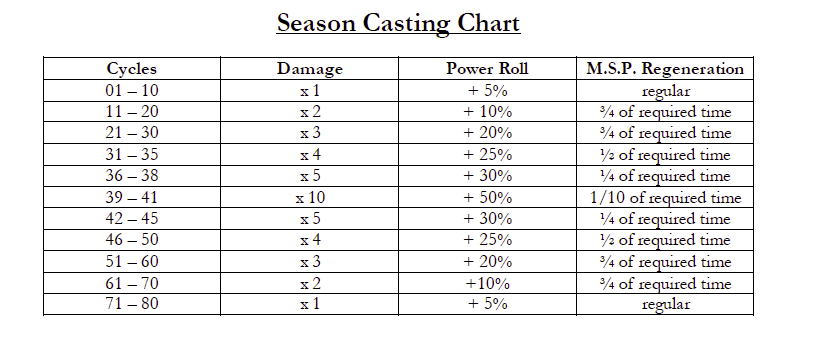
So Mages get multipliers to damage no matter what, depending on the time of the season. This stacks with other damage multipliers. There is a very real chance that a mage will oneshot either themselves or someone else.
The next section concerns something called a Wrey-nger. I do not know what a Wrey-nger is and the book does not want to explain what they are. The only reference to them I can find is on Page 472 of the book
Wrey-nger
The only spells a wrey-nger can cast with any certainty (the same certainty as any other mage) were
the spells he/she knew prior to becoming a wrey-nger. The rest of any other spells the wrey-nger
attempts at casting comes at a risk (see wrey-nger charts). For these spells may or may not work; has
a risk of backfiring on the mage; and if they do work, have varying amounts of damage and the cost
of magic source points to deal with.
In order to keep a wrey-nger alive, it is best to remove your Ring of the Magi (if you have earned
one of these yet) and not wear any clothing that would distinguish you as a mage. You must learn to
hide your casting, if possible, and blend in with a crowd.
This does not tell me what a Wrey-nger is. In fact, it raises more questions than it answers! Regardless, they have their own tables:
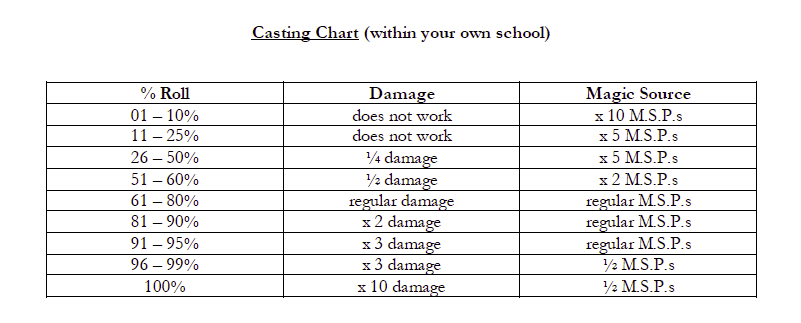
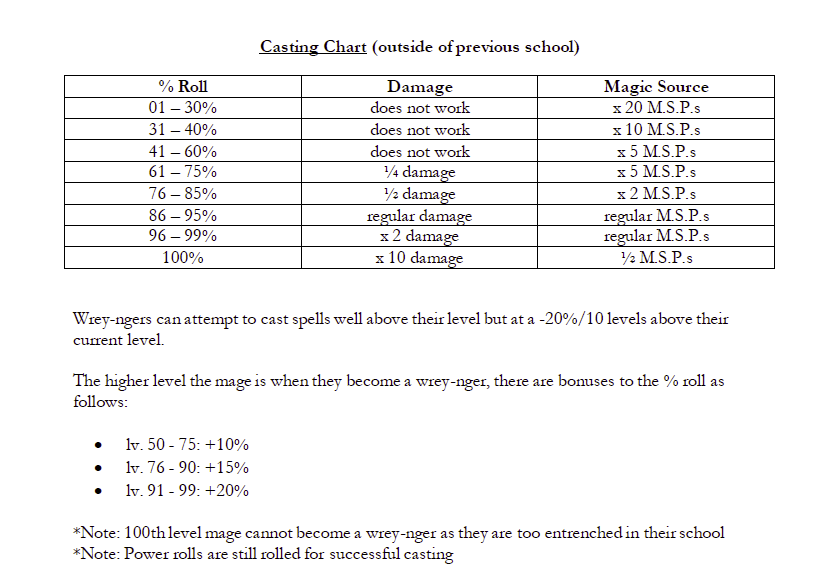
I do not know what the implications of a mage becoming a wrey-nger is, and frankly it frightens me. This is the end of the magic casting section.
More Charts!
This section is called More Charts because it contains more charts. Charts for all sorts of things you may or may not attempt while playing this game.
Learning Curve
These rolls are used whenever a character is attempting to learn new things (ie: new languages, new
weapons, wrey-ngers learning new magic, etc.):
01 – 25%: gains nothing
26 – 50%: learns a little but not enough to use
51 – 99%: learns enough to use
100%: masters the lesson*
*Note: if a wrey-nger masters a new book, they cast as if it was their own school
Dang, I thought I was done with wrey-ngers. This is a fairly standard chart for learning something new, but I will note there’s no time scale associated with it. I can look at a language and make a roll and suddenly become a master of it in a single instant. What else do we have?
Diplomatic Rolls
This chart is used any time a character is trying to avert battles by talking their way out of an
encounter or when they are dealing with dignitaries or leaders of countries:
01 – 30%: backfires and either a battle or a war is started
31 – 60%: tension is still there but they are willing to negotiate more
61 – 99%: tension is gone but they are still wary
100%: becomes allies
Politics, am I right? There’s a 1/3 chance you start a war whenever you try diplomacy with a leader.
Dickering Chart
This is used any time a character tries to get a better price for items they are selling or buying:
01 – 20%: will either pay x 4 or will lose x 4 off price
21 – 50%: will either pay x 2 or will lose x 2 off price
51 – 80%: pays going rate either way
81 – 99%: will either pay 1/2 or gains x 2
100%: will either pay 1/5 or gains x 5
Not once have I ever heard someone refer to bartering as “dickering”. I’m sure this table plays well with the racism pricing chart from the jewel enchantment section.
Attraction Chart
This is used whenever a character tries to attract others to their cause:
01 – 25%: no one comes
26 – 50%: 1-10 responds
51 – 80%: 1-20 responds
81 – 99%: 10 – 50 responds
100%: 100 – 300 responds
Have you ever been lost in the woods only to summon 100-300 helpful strangers when you call for help? I’m sure its happened to all of us.
There will be more tables soon, I promise, but that’s the end of the extra charts.
Calculating Experience
Whew, okay, we understand how to make a character and perform combat. Now how do we advance in this game? Well like any traditional RPG, there are two things you want more than anything else: kills and magical stuff.
Experience points are amassed through encounters and recovering magical stuff. When groups meet
enemies in the field of action (encounters) and a certain number of the enemies are slain, the total
amount of accumulated experience points (total number of enemies slain x experience points per
individual = total experience points) are divided by the number of members in the party (everybody
takes part somehow in an encounter situation)**.
Okay, easy enough. Every enemy is worth some amount of experience, and then this gets equally distributed between players no matter how they participated in the encounter. Surely it can’t get more complicated…
After all the good stuff is gathered up, the members of the winning party role [sic] their % dice to
determine who chooses first (it always helps if there is a person in the party who can detect magic;
then the party will at least know which items contain magic of some kind; otherwise it would be just
a long sword or just a brass ring). The items are chosen one at a time and experience points are
given out by the item chosen (actually the experience points are given for the magic the item holds,
not for the item itself ).
Oh no. Looting magical items gives vastly different amounts of experience based on who loots them. This means that experience points are going to vastly differ between players, based on how they draft them. Luckier players will roll first and pick the super powerful magical item, and then the rest get the dregs. Not only this, Holland seems proud of this fact. I’m including an example image of a scenario he included:
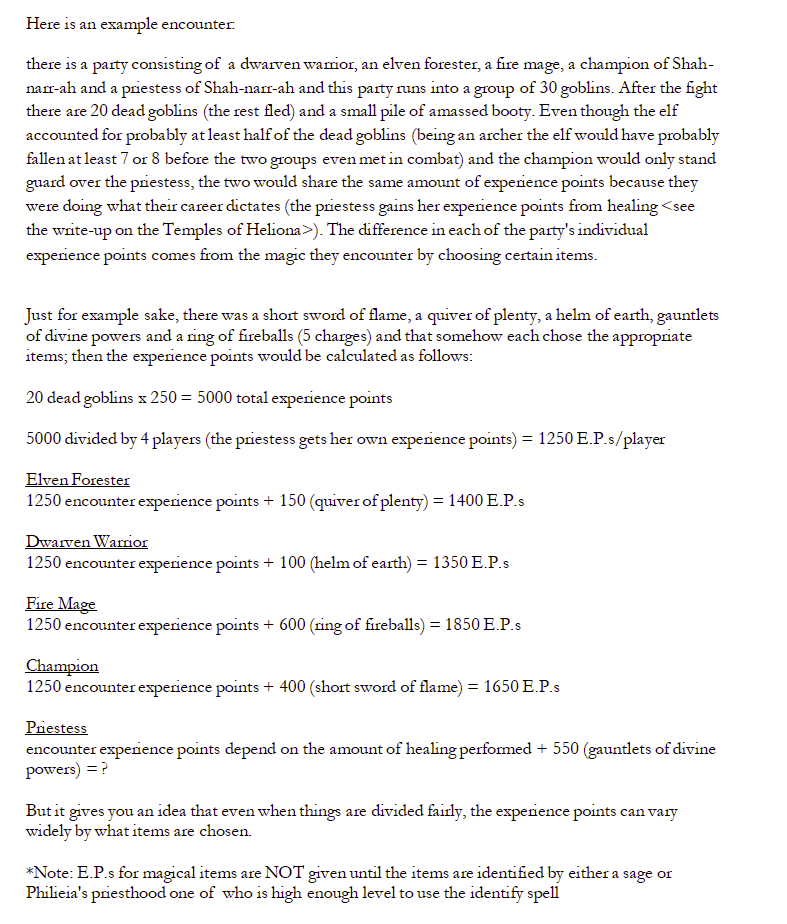
Once more for the folks in the back: BEING A PRIEST SUCKS. Everyone divvy’s the experience up and the priest gets nothing except for what they heal. Also, they have to haul all these things back to a Sage or very specific priesthood in order to actually earn the experience from items.
Back in the day, distributing experience based on monster kills was the standard, so its hard to fault it. Even 5th edition D&D has rules for it as a baseline, though many opt to use milestone leveling instead. Including magic items and MMO tier loot drama in the mix is a recipe for disaster.
Encounter Charts & Compodium[?]
Good news dear reader, we are now on page 56 of this 545 page complete tome. Don’t worry though, the next 128 pages of the book are encounter tables, monsters, and NPC statblocks. These range from goblins and giraffes, to Par-traxx (believe me, we will be talking about Par-traxx). I assume you all know what a goblin or giraffe is, so I can skip over most of the pages here. Instead, treat this as a greatest hits of the monsters in this book.
Cities (night) 60% chance for encounter
01 – 09%: thugs (6-36)
10 – 16%: pick pocket (4-32) (60% chance it is a gnome)
17 – 31%: rogue (6-24)
32 – 35%: mage (1-4) (55% chance of being evil)
36 – 41%: hooker (1-20)
42 – 44%: assassin (1-2) (60% chance assassin is looking for player)
45 – 70%: city guard (2-40)
71 – 79%: thief (2-16) (60% chance of targeting player)
80 – 85%: dwarf (2-20) (40% chance of being evil)
86 – 88%: priest (1-4) (50% chance of being accompanied by a champion)
89 – 90%: elf (2-12) (15% chance of being Shai Elf)
91 – 94%: knight (4-16)
95 – 97%: spy (1-6)
98 – 99%: Special II
100%: Dragon (roll on Dragon Encounter Chart)
Remember, you’re equally likely to encounter a hooker or dwarf in a city at night. The special result is another set of special tables with all sorts of magical creatures and NPCs.
Dream Stalker 0 E.P.s
Dream stalkers are interesting beings that reside in the Dreamscape Dimension. They attack by
finding their prey through their dreams and therefore have no fear of being attacked themselves for
their prey is always asleep. None will ever know they have been attacked by a dream stalker as there
is no pain, no damage or anything of the sort. The only way anyone knows they have been attacked
by a dream stalker is that they wake up in a completely different place (usually 1 – 2 countries away)
than they went to sleep with only what they had on their person before going to sleep (ie: the clothes
they were wearing and any rings or medallions they had on at the time). All the rest of their stuff will
be left behind where the prey went to sleep.
Should anyone venture into the Dreamscape Dimension to attempt a confrontation with a dream
stalker, the creature will just disappear from the area you are in.
In Atlantasia, there’s a chance you’ll be teleported 1-2 countries away when you fall asleep, possibly in your underwear. There is no way to prevent this from happening, and if you try to confront the cause they’ll just teleport away. Even if you tried to kill it, it has no stats and is worth 0 experience points, so why bother?
Sea Weed 50 E.P.s
There are two types of sea weed on Atlantasia; there is regular sea weed, which all alchemists seek
for making potions with, and there is a type that feeds off small amounts of flesh, which is the type
we will discuss here.
The only way to tell the difference between the two is to do a bit of experimenting when you see
water with sea weeds all over it. The best way to discover which type is to throw a bit of meat into
the water. If the sea weed wraps around the meat and begins to slowly devour it (it will take about
10ss for a 2″ piece of meat to be fully devoured) then you have found this breed of sea weed.
As stated, there is no real difference in looks between regular sea weed and the flesh eating sea weed
(unless you look on the underside of the water and see small mouths hanging at the end of the
strands of weed).
Sea weed, when a prey makes the mistake of being trapped in the midst of the weeds, will attack in
groups. They secrete an acid that will eat through tough hides, leather and non-magical metals to
give the weeds access to the skin and meat below. While their bites might only feel like large insect
bites, many an adventurer has lost a good set of boots and breeches to these creatures (as well as
gaining a major chance of lethal infection from unattended bites). Sea weeds do not eat very much at
a time (although large groups have been known to kill smaller animals who venture into the water).
Because of the vast amounts of water contained within these weeds, fire is not your best approach
to dealing with these pesty beings. However, they have very little defense or L.P.s so killing them is
fairly easy (if you can catch them). Their main defense is speed! These weeds can move at the rate of
75’/ss and will scatter in all directions if attacked.
If you weren’t already afraid of the ocean, you should now be. Indistinguishable seaweed mimics that are common enough to be a known threat, and they also burn through your precious armor durability.
Looking at the stats:
Attacks: 1/ss
To Hit: 95% (if within 2′ of the weed)
Defense: 5%
98% immune to fire
L.P.s: 15/weed
Physical Attacks: Acid Saliva (will eat through above items at the rate of 1d6/ss and there is no way
to rid the articles of this saliva)
Bite: 1d4 – 1/bite
0% chance of anything magical (1% chance of magical things under the water)
You can never get rid of the saliva, your armor and weapons are just gone if you ever go swimming and run into this thing.
Floater 125 E.P.s
Floaters are another interesting creature. In reality they are 3′ – 5′ long, thin and slimy (picture a
leech). They have no eyes and their entire front is a gaping mouth with small, sharp teeth.
When encountering a floater, they will not look anything like their true self. Instead, you will see an
illusion of their last victim (right down to the armor and clothing they were wearing). If someone
was to see this being floating in the water face down and went to turn them over or see if they still
lived, the floater would abandon the illusion and attack straight to the face where they will sink their
teeth into the flesh and drag you to the bottom trying to drown you. Their mouths expand to try and
engulf their prey’s mouth and nose, thus assisting in the drowning.
Once again, give me any reason to go near water on Atlantasia. I won’t do it.
Leetch 0 E.P.s
There are two types of leetches one has to worry about on Atlantasia. These are not even related to
regular leetches that hang around in still waters, but are called leetches for the type of attacks these
beings do.
Brain Leetch
A brain leetch is a nasty little creature that is less than an inch long and no bigger around than a
small needle. They only attack at night and will squirm they way up a target until they find an ear.
Then they enter the ear cavity and settle beside the ear drum. This is where they begin to feed. There
is no pain involved so it is rare that anyone will notice they have been attacked. However, within one
cycle the one targeted will begin to lose memories as the brain leetch feeds off one’s memories.
Should this go for one full season without the leetch being removed, the one infected will lose all
memories; including who they are and what they did for a living. They will lose everything! And
these memories will never be able to be retrieved, so they will have to be trained for another career.
Oh good, the brain parasite a size of a needle that will enter your body with no pain or discomfort and give you total amnesia with no other signs of illness.
Shadowpeople came from another dimension and decided to settle on Atlantasia (in an area of the
Southern Territories called Shadowland). They got their name because shadowpeople have no true
form. They are THE masters of illusion and delusion (their illusions make a 100 lv illusionist seem
like a beginner). Very rarely do shadow people venture out of the safety of Shadowland, however
there are some who do. The unfortunate thing is, if you do run across one of these beings you will
never know it as they will take on whatever form they wish (even the spell true sight will do you no
good).
Random illusionist slander out of nowhere?
Hey remember Dream Stalkers? They have cousins!
Dimensional Stalker 0 E.P.s
Dimensional stalkers are another interesting being that comes and goes without anyone truly
knowing about it. These beings travel the dimensions in search of those who have just died. When they encounter this, they will absorb the corpse’s soul and go off in search of another being still alive
to drop this soul into (usually being the opposite in alignment as the one who died).
Dimensional stalkers will do no damage to anyone; they have no true form (they are energy beings);
and there is no way to attack them. They pick up the souls whenever they can, but will only drop
these souls at night when their target is asleep.
Dimensional stalkers are a very distant relation to dream stalkers.
If you die on Atlantasia, there’s a very high chance you get to Freaky Friday a person of the opposite alignment.
Not even the rats are safe here:
Eyed Death 900 E.P.s
It is extremely difficult to tell the difference between a rat and an eyed death. They are the same size,
they act the same and they hide in packs of rats! So, how DO you tell the difference? Threaten them!
When eyed deaths feel threatened four eyes emerge from the top of its head and these eyes will
erupt with spells from each element (1 element per eye) in all four directions. They will rotate every
ss.
(…)
Special Attacks: front eye: minor fireball (2d20)
right side eye: minor lightning bolt (2d20)
back eye: ice chards (5d20)
left side eye: mud balls (1d20)
Imagine disturbing some sewer rats and suddenly being blasted with fireballs, lightning, ice, and mud.
Meridian Lizard
It is absolutely FORBIDDEN to kill a meridian lizard. They are sacred to many as these creatures
follow the energy lines of Atlantasia.
If you are searching for the best spot to cast a spell; if you are searching for the perfect spot to set
up a temple; then look for one of these small lizards (about 6” – 9” long). The stripes down their
back will change color relating how powerful the energy line is.
Should anyone be caught killing a meridian lizard (and you WILL be caught), you would owe a quest
to the first Deity that shows up after the death of the lizard (usually 3 – 10ss).
It’s really unfortunate that the gods care more about some Brazilian reptile than their own priests.
Unicorn (costs you the life of one you love )
Unicorns are beings of pure heart! They would never attack unless they were threatened (or those
endeared to the unicorn is being threatened). Because of this pureness of heart, any who kill a
unicorn (and good luck with that) will forfeit the life of one they love and the Deities will ensure this
will be done.
Unicorns have an excellent relationship with the Elemental Guardians as well as any of the beings
from the Fairie Realm. Should you kill a unicorn on the island of Xyla, you will be facing every Fairie
Being on the island with 2ss. While the Deities will take one the killer loves, the Fairie Beings will
take the killer’s life.
Unicorns will give directions to anywhere you are going within the unicorn’s forest if the question is
directed and asked with the respect the unicorn expects.
Turns out the gods also love Unicorns more than they love their priests.
Chaos Dragon 5000 E.P.s
Chaos dragons are probably the most interesting (and most dangerous) of all the dragons. They also
propose the biggest difficulty in killing any of the dragons.
The scales of a chaos dragon shimmer between black and silver (or the darkest purple and silver)
and are 40′ – 80′ long (making them the smallest of the dragons). However, do not let their size fool
you, they are also the most magical of the dragons.
It is because of chaos dragons that the Season of Chaos exists. This is the time chaos dragons mate.
During this time, male chaos dragons take the females on a mating dance that takes through every
dimension they can (some people actually get caught up in these dances and get deposited on some
other dimension <30% chance someone in the group will be caught>). Also, because of their pure connection with the magical energies, the magic follow the dragons thus making magic (those the
magi use) unstable and unreliable.
This is by far my favorite of the generic monsters, because of how batshit insane it is. During the Season of Chaos, there’s a 30% chance that someone in your party will be teleported to another dimension with no recourse, after a couple of dragons fuck their way through time and space. It could happen to you!
We’re now in the actual NPC section, where the really juicy content is. It starts with Par-traxx, but I’m going to save him for last.
Let’s start with the Nazgul Riders of Destiny:
The Riders of Destiny 2000 E.P.s (each)
The Riders of Destiny were formed by the disgraced and disposed God of Fate (whose name is only
remembered by Rann (the Chronicler of Atlantasia) and Par-traxx ). Before he was thrown from the Pantheon (for interfering in the lives of mortals), he obtained one of the ancient scrolls (far out dates Atlantasia) which he used to form this small army.
The sole purpose of this group is to wander Atlantasia and collect every relic the Deities created and
store them in a forgotten island in the middle of the Boreal Ocean (the deposed God of Fate wants
control of every relic in order to gain back control over the mortals of Atlantasia).
What completely makes The Riders of Destiny different than any other group is that not only did
the ancient scroll bind the riders to the ex-Deity, it also allows each rider to share their abilities (and
powers) and it gives each rider a telepathic link to each other. This magic makes the riders unaging
(not immortal, they just do not age).
They will only appear if the group is in possession of a relic. If the relic is essential to the quest the
group is on, Par-traxx will appear before any in the group dies and then the rider will disappear.
You will only ever run across 1 rider at a time (for which the players will be thankful of), however, it
is like running into them all at the same time.
Oh hey early Par-traxx jumpscare! He’ll be around, don’t worry about it for now.
The Riders are a bunch of generic edgy NPCs from all walks of life and professions, none of their backstories are even remotely interesting and they range from level 60 to 99. Fun fact, one of them is an Eastern Monk, and the text refers you to the Eastern Realms book for stats. I’ll get right on that.
Moulaan 1900 E.P.s
Moulaan is THE king of demons; the biggest, baddest demon of them all. He appears to be a
noble/prince demon but much, much larger (he stands 75′ tall). He also carries a mace that makes
noble/prince demon’s maces look like toys as well as a gigantic flaming scythe.
Totally epic my dude.
Kraygon 1000 E.P.s
Kraygon is a man of mystery (no one truly knows what he looks like as he is disguised every time he
meets anyone). He is a 100 lv assassin and thief who is in possession of some very powerful magical
things that assist him in his work (see below for a list).
Kraygon will only show up if there is a relic or artifact within the group as he is hired to gain these
for his clients (he was the “Relic Hunter” for the Brie-ton Thieves’ Guild) and he is extremely good
at what he does.
His specialties are: blade master assassin and trap master thief.
You’re probably catching on that most of these NPCs sound like self-inserts that are the coolest and baddest dudes in all of existence. I’m reminded of Magic the Gathering’s Legends set, where the developers created cards based on the characters they played in their personal D&D groups and introduced them with no context. That’s how you wind up with cards like Angus Mackenzie completely devoid of any real meaning. That’s how most of Atlantasia feels, you’re given a bunch of worldbuilding information but lack any of the context to place it in a meaningful capacity. Are these just characters Holland came up with? Did these arise out of his D&D and AD&D campaigns? Are they reskinned versions of existing commercial properties? Who’s to say?
Miraje 0 E.P.s
Miraje is a very good natured shadowperson who is a master spy (100 lv). Miraje has found no
reason to kill anyone (unless you are a necromancer, which Miraje is not ) and if any were to threaten Miraje, Miraje would just create a different reality in the area and disappear.
Should an encounter with Miraje occur, the player(s) must discover who, or what, Miraje is first (the
players will sense someone watching them in the area they are in). Then you could ask Miraje for
information but it will cost you dearly (x 10 to sage prices).
“Pssh, nothin personnel kid” *creates alternate reality and disappears*
Three Evil Brothers
There are three brothers who have been around Atlantasia for an extremely long time. All of them
are UE and while they COULD run around killing everyone they run across, they generally just use
the races of Atlantasia for their own amusement. They always have a Shai-Elf mage with them that
they will use for a quick exit (or as a means to keep their tower in another dimension).
These brothers, designed for their amusement, created a tower and the elven mage put it into
another dimension. They use this tower to trap unsuspecting adventurers who must find their way
through the entire tower before being allowed to leave (see the appendix 1 Free Campaign).
Should anyone be foolish enough to try and battle these brothers, their demise would be inevitable
(it may just take a while as these brothers are very sadistic (especially Tass-mer).
Two Three Brothers Honestly, none of these dudes are interesting beyond being sadistic edgelords. I did find this section really funny though:
Unknown to anyone, including his brothers, is the fact that Mor-ell is actually the one who runs the
Assassin’s Guild for all of Atlantasia. Even though he is not an assassin himself (actually he has
never assassinated anyone) he was the one who started the guild and then disappeared into the
background.
“It was just a prank bro, I’m in charge of all the assassinations in Atlantasia and I never actually killed anyone! It’s all a big goof!”
Rann 0 E.P.s
Rann is the official historian of Atlantasia and known as the Chronicler. He was made immortal by
the entire Pantheon because of how absolutely neutral his views were and the added advantage of
having the medallion which contains the Spirit Dragon (demi-goddess light dragon) who will appear
if ANYONE ever even thinks of harming Rann.
He is 5′ 8″ tall and has long grey hair which he ties into a tail. He will be wearing browns and greys,
always has his glasses perched on the tip of his hawk-like nose.
Rann can always be found in the university in Baba-Luna and since Rann knows everything (and I
mean everything) that is happening around Atlantasia while it is occurring, Rann is the most
knowledgeable sage on Atlantasia (and thus the most expensive ).
Rann does have a soft spot for gnomes and will generally identify items for gnomes at no cost (and
take them to the proper temple if they have put on a cursed item).
I wonder if Rann knows why nobody bought any copies of the Realms of Atlantasia. At the very least I bet he knows what is in the other books that keep getting referenced.
Okay, I’ve stalled long enough. It’s time for the big daddy of self inserts. Par-traxx’s description is the longest of any NPC. He is worth 0 experience points.
Par-traxx 0 E.P.s
Par-traxx is an enigma on Atlantasia. Here is what is known about him:
- he is a Moon Elf who became the first Dragon Mage (combined with the Demi-god Chaos
- Dragon)
- he has been known to show up in many different looks and personas
- he lives in the Crystal Tower which is located in the Nor-Scand Mountains
- he is the idol of almost every Elven Mage
- he is 5′ 1″ tall and weighs 79 lbs.
- he is always seen with his familiar Terronis (a large black bird with red splotches in its wings)
- he is always seen with a black/gold staff that is 6′ high
What a cool dude, the epic Moon Elf Half-Demigod Chaod Dragon with a cool bird and sick staff. Everyone either wants to fuck him or be him, what a badass. Now that’s all beginner shit, we need the real deep lore on this dude:
That is what is known around Atlantasia by any who are able to read or have been to a bard’s
performance. Here are the things no one knows about Par-traxx:
- his familiar is actually a 75′ phoenix
- the staff he has with him is actually the relic The Staff of the Cosmos (which he keeps with him so no one can wield its tremendous powers )
- he was the one to teach the War Magi how to create their shield which absorbs energy and uses that energy to strengthen itself
- he knows and can use ALL forms of magic
- the biggest thing not known about Par-traxx (none of the Deities even know this) is that he
- is actually the avatar of the original creator of all the known universes and dimensions
So Par-traxx is just god. You can’t deal with him. What happens if you do?
Because of this last point, Par-traxx cannot be touched physically, mentally or magically. If
confronted, Par-traxx will use the following tactics in order:
- he will first try to talk the antagonist out of the confrontation using a logical approach
- if that does not work, Par-traxx will unleash his familiar in its true form (he will cast a fireball
- in Terronis’ direction)
- if they continue to press, he will alter his own form into that of his ancient Chaos Dragon
- if this fails (and the antagonist is angering Par-traxx), he will scatter their atoms across every known plane of existence and dimension, allow those atoms to retain all the knowledge of the plane of existence/dimension they were in. Then he pulls the atoms back together using the line “knowledge is power and all you seek is power so that is what I have given you; ultimate power”. While Par-traxx cannot destroy anything or anybody (after all, he is THE creator), this has been known to kill any this happens to (there is 1 person who survived and now wanders Atlantasia babbling to himself as he attempts to organize all the information his mind holds now )
“knowledge is power and all you seek is power so that is what I have given you; ultimate power” oh god oh fuck I’m sorry Mr. Par-traxx I didn’t realize you were serious.
At the very least you could just not run into him, after all the dude’s a legend, he’s not gonna be hanging around a bunch of random adventurers… right?
Par-traxx can be used to insert quests into a group (he is famous for this). He will either show up in
your camp out of the blue (10% of the time) or be situated somewhere in any form you wish (he has
probably used the form before so be creative; he is!) where the group will pass by him.
You now have this author self-insert stalking the party giving them random quests and there’s no way to get rid of him. Wonderful.
And that’s the section on on Monsters and NPCs. Have you learned a lot? We’re still not halfway through the book yet.
Treasures
Pages 185 through 252 are on treasure, including magic items. I want to divert for a second and write about something that I’ve sorta glossed over up until this point: the formatting in this book sucks. Its hard to properly convey how bad it is across the text blocks I’ve quoted, but it is almost entirely plaintext, stream of consciousness writing. There is little formatting, use of tables, bulleted lists, etc. This blog post may somehow be better organized than the book itself.
I think what gets me the most is the inconsistency. Sometimes it uses nice tables with actual grids, where columns and rows are given proper headers and its clear what the contents are. Sometimes you get fucked up abominations like the Magic table here:

I think the lack of illustration is what really seals the fate of the book. Much like this post, its an endless scroll of black on white text with nothing to actually look at but numbers and bizarre writing.
Back on the treasure section, it inexplicably contains the entire magical potion section from earlier just copy and pasted here. The only difference is that it has an asterisk with the following disclaimer:
*Note: all these potions are only sold by the person who developed the recipe and NONE OF
THEM WORK!!!!
Why even bother including this? Seriously, this takes up 2 pages of the text just to repeat information already presented, only to immediately invalidate it. You could just as easily have an NPC vendor with the footnote “Their stock includes all the magical potions from page XXX, except they are fake.”.
For most of these pages, you can feel the Diablo influence oozing off the page:
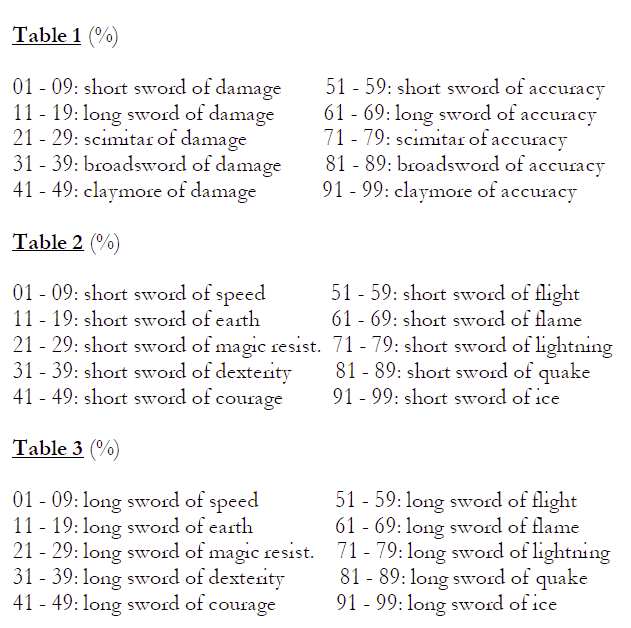
There’s a table for literally every single item type, and they all follow this same formula. To actually understand what the items do, you have to skip all the way to the end of the section to consult another huge table of every single suffix and its meaning. None of these are particularly interesting, they usually boil down to a small increase in attributes, resistances, or skill percentages. The specialty magic item suffixes just give spells…. 1-20 of them, GM’s choice. I think my favorite one is the “of mental powers” suffix, which lets you cast two spells at once. There aren’t any rules about this, but sure, now your Priest can suck twice as hard.
Skipping backwards before the big table, there’s a list of artifact-tier magic items. Time for another best of section:
Tiara of Queens 100 E.P.s
This artifact originated in the swamps of Friss-ill-ikka. It was developed to assist the Snake Queen
(however the line of Snake Queens found they did not require it and it disappeared from this
country).
It is a small silver crown with 5 diamonds embedded in it. It is only usable by females and none of
the magic will even accept a male wearer (it will fly off any male who tries to put it on and will give
them 10 points of damage). It has a durability of 20 and no strength requirement.
Females who don this crown will receive the following:
- + 4 to magnetism;
- + 1 to charisma;
- + 3 to psychic defense;
- – 5 to psychic strength; and
- + 15% to defense
Gender affirming sexist crown!
Chara’s Wreath 150 E.P.s
Chara was a High Priestess of Khiet-sheen (no one really knows or remembers which side of Khietsheen
Chara worshipped) who was so drawn by the saying “justice is blind” that she designed this
artifact.
It is a gold silk scarf with only a durability of 1 and must be worn somewhere on the body to gain
the magic from it. What this scarf will do is give the holder second sight and turn the holder
permanently blind.
If one of the priesthood of Khiet-sheen wears this scarf they gain:
- x 2 to spells granted/cycle;
- a telepathic connection to the chosen of your alignment
If this artifact is destroyed, it will reform somewhere else on Atlantasia.
Remember how items have durability? Yeah this one specifically calls out it has exactly 1. This thing isn’t sticking around for long, and it also makes you permanently blind. Also, based on the phrasing I assume that losing it also takes away the second sight? Raw deal.
Nyhcher’s Medallion 300 E.P.s
Nyhcher was a street urchin who was disgusted at his status in life. He was sick of being broke and
hungry all the time, so when he stumbled across a plain wooden medallion with an unenchanted
jewel (pink) in it, he convinced a mage (who also grew up in a fairly poor family) to enchant the
jewel.
If someone from a middle class family or lower has this medallion, they gain:
- acceptance into any noble’s estate with welcome arms;
- + 50% to any finances found;
If anyone from noble blood was to wear this medallion, they would give away 1/2 of their family’s
finances and all their jewels and gems.
Where do I even start with this… communist-capitalist medallion?
Amulet of An-Dohr-Ah 30 E.P.s
This is a strange looking twisted twig with a bear claw in the middle.
Any who wear this amulet moves silently 100% and without any trace of passing.
When put on by a druid, the wearer can call and control 1-10 bears in the area once/cycle.
When put on by a forester, the wearer can change form into a random bear for 10-20ss once/cycle.
I love how this book always has to specify ranges when you really don’t need ranges, and one end of the range is an extreme. Like yeah, sure, maybe you’ll get 10 bears I’m sure that will make combat more fun and engaging. Also if you’re a lumberjack you can turn into a polar bear (random bear, remember?).
Anton’s Treasure 10 E.P.s
This is a small wooden chest made by the mindweaver Anton Brashear. Any who find this will find
an unlimited supply of platinum chips within the chest. Unfortunately, whoever opens this chest
immediately becomes Anton’s slave for 10 rebirths (no way to remove this curse) and after the 10
rebirths the chest will disappear.
*Note: only a 50 lv. or above mindweaver has the possibility (30%) of repelling this enchantment
Infinite money glitch found REAL.
Ring of Percel-aan 90 E.P.s
This is a small, silver ring that even a sage (except Rann) will identify as a ring of life. After putting
this ring on, within 2 cycles the wearer turns into a zombie, wandering around waiting for someone
(anyone really) to tell them what to do. This is a cursed item and only a 100 lv. priest/priestess from
Heliona can remove it.
Can you imagine the level of GM spite needed to come up with something like this? Can you imagine this situation playing out at a real life, honest to god table and the player not beating the shit out of the GM for pulling this?
I’m not going to include the examples here, but there are many magical items which fall into two categories. The first is “Magic item tied to location” where simply having the item makes you king or leader of a certain group of people, just for holding it (very Arthurian). The other type are magic items that upon picking a single one up, you are immediately compelled magically to go on a quest and retrieve the others in the set. I suppose this is a kind of story hook, but it’s really forced.
So those are all super rare artifacts, but what if I told you there are even more powerful Relics? These bad boys give you no experience for picking them up (why?) and are super hidden, looking busted up and emitting no magic, while also being indestructible. I wonder what these are like?
Crown of Power
This relic was made by the Shadow Dragon demi-god Pael-zar-grann-dazz. The only character this
will have any benefits for is the mindweaver. This was Pael-zar-grann-dazz’s attempt at convincing
the mindweavers to share with the dragons how the mindweavers are able to manifest their thoughts
into reality (the only type of “magic” the dragons cannot perform).
This crown is a wreath of vines with a small, dark purple jewel in its center. This is the one relic
every mindweaver is searching for (it has been lost for over 8000 rebirths). To a mindweaver, its
powers are unequalled.
*Note: this relic will ALWAYS be found in the Forgotten City which lies under tons of ice on the
Southern Ice Cap Tundra.
For the mindweaver who gets their hands on this relic, they will gain:
- x 10 to all weaves used;
- allows access to 3 levels above the level they are on in their primary discipline;
- gives the mindweaver the ability to link with all mindweavers (except Anton who has discovered a way to block this) and draw upon their energies to empower their own weave (think of the power behind that weave);
- the mindweaver can also, through the crown, learn the other disciplines (although true telepaths do not give up their weaves very easily)
Its a weird writing trope that Holland has where certain people or things are desired by all members of a certain group. Like how Par-traxx is the idol of literally every elven mage, literally every mindweaver wants this thing. Also, who the fuck is Anton? They had their magic slave item in the last set, but they inexplicably are here too being some kind of Mary Sue. They never show up again in the book by the way, I checked.
Book of Knowledge
This relic was made by the minor Deity Psy-Nah-Moray. It is a leather-bound tome filled with many
pages. If anyone other than a sage (or someone with a minimum intelligence of 13) opens this tome,
the pages will be blank and no ink will penetrate the pages.
*Note: this relic will always be found on a shelf in some library and will look like any other book on
the shelf.
This relic is prized by any sage and they will make tremendous deals with any who find it (usually
free identification of magical things and free information about areas). Any who can read the words
in this tome will have access to any information about Atlantasia that they wish (you just have to
have a question in your mind and open the book to any page and the information will be there) for 1
full season and then the relic will disappear to another library.
There’s just some kind of cosmic humor to this item existing, considering that nobody can answer any questions about Atlantasia. The Game Master’s Bible is Plato’s Allegory of the Cave, we see shadows of a custom RPG world that presumably exists in some dude’s head, but we can’t grasp the true form since all we get are references to it.
I genuinely think I’m going insane reading these. All of them are the same item over and over again, just with a few words changed. They all follow the same exact formula to the letter. Here, lets do an exercise! Create your own Atlantasia Relic with this helpful mad lib:
[ITEM TYPE] of [CONCEPT]
This [ITEM TYPE] was created by [GOD] and is only usable by [RACE OR CLASS].
* Note: this relic will only appear to be [DESCRIPTION OF MUNDANE THING] and can only be found in [GENERIC LOCATION]
Nobody but [RACE OR CLASS] can make this item take its true form. When they do so, it will transform into [FANCY LOOKING VERSION OF ITEM TYPE].
If [RACE OR CLASS] uses the [ITEM TYPE], they get:
- [RANDOM GENERIC BUFF]
- [ABSURDLY HIGH SKILL PERCENTAGE INCREASE]
- [COMPLETELY BROKEN ABILITY THAT MAKES THIS ALREADY BROKEN GAME WORSE TO RUN]
Feel free to share your unique and interesting homebrew relics in the comments!
Now that we’ve finished treasure (finally) we can move along to…. class progression again?
Stuff that was inexplicably left out of the character section?
So turns out, each character class has its own section that contains information on what they get when they level up. These include proficiency bonuses, how many attacks a class gets, and how much EXP until the next level all the way to 100. Admittedly, I’m skimming these huge blocks of numbers, but to give you an idea:
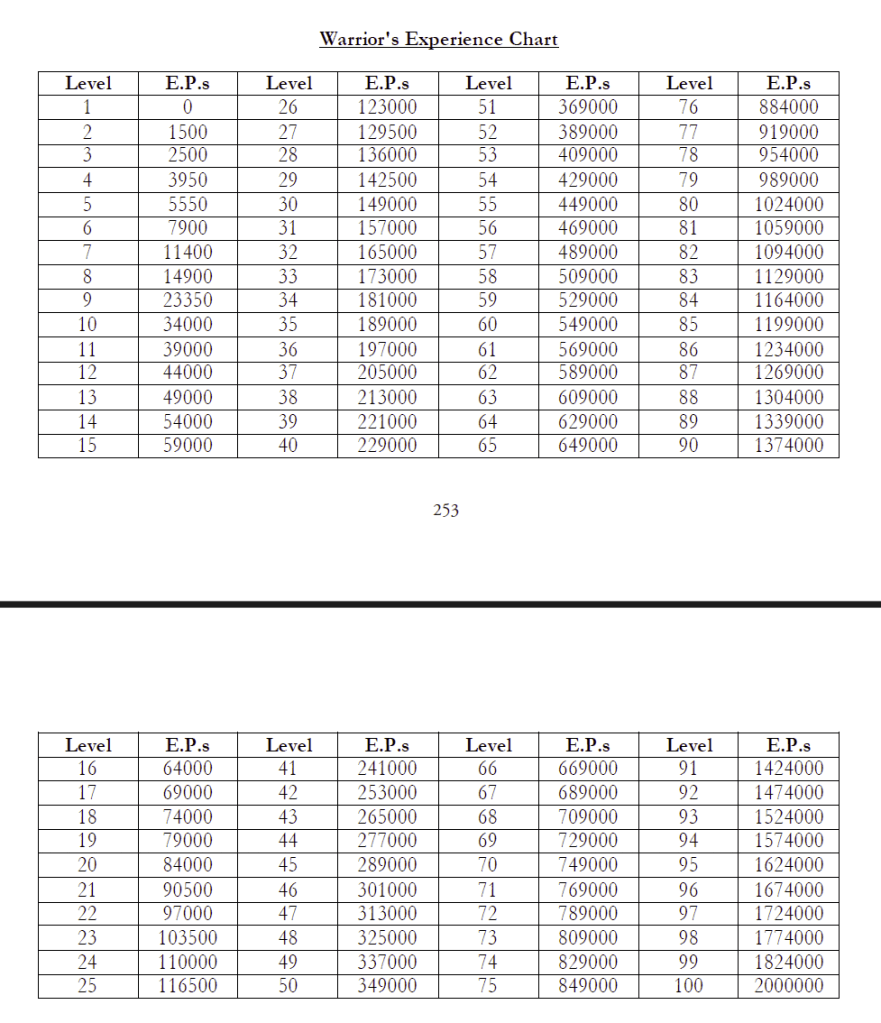
Turns out things are worse than I thought when it comes to consistent progression for characters. Not only does distributed loot negatively affect the rate at which characters level up, each class has a completely different exp table, with some requiring more or less. They seem to start the same, but as you climb up they begin to diverge wildly. Level 100 for a Warrior requires 200000, but for a Champion it requires 260000. That’s a really big difference.
Also, some classes get special tables that show how their skills advance for the first 20 levels, like Foresters:

Other classes just get nothing, only basic descriptions and experience.
The Nightmare that is Priests
We’re finally here, the progression for Magic classes! We can really dig deep on why Priests are so bad!
All magic classes start with 3 spells, then they get 2 spells with each level until 10. After that point they get another spell every 4 levels, until completely inexplicably they get a spell every 2 levels from 90-100. The level of available spells also increases with character level, but it follows a different scaling for each class.
The Priesthood
Every one of the Priesthood has several things in common. These include:
- the right to choose to become a Champion for their cause at level 25 (except a Shaman)
- how spells are casted and the amount of spells granted per cycle
- certain tasks they MUST perform each season (otherwise there WILL be consequences).
- These chores begin at level 10.
- levels of experience
So Champion is a higher level of each temple, they get their own bonuses at that point. The two things that are worrying are the “how spells are casted [sic]” and the chores (there WILL be consequences). We get the answer to the first immediately:
Every spell the Priesthood casts takes 2 s.s. to perform. The first round is spent praying to their Deity,
asking for the spell they wish and the second s.s. is when the spell takes place.
The Priesthood is granted a maximum of 12 spells per cycle (depending on the retention of your
character) and their Deities regulate these spells as follows:
level 1 – 10: all are apprentice spells
level 11 – 30: 3 level 1 spells, the rest are apprentice spells
level 31 – 50: 1 level 2 spell, 3 level 1 spells, the rest are apprentice spells
level 51 – 70: 1 level 3 spell, 2 level 2 spells, 2 level 1 spells, the rest are apprentice spells
level 71 – 90: 1 level 4 spell, 2 level 3 spells, 2 level 2 spells, 2 level 1 spells, the rest apprentice spells
level 91 – 100: 1 level 5 spell, 1 level 4 spell, 2 level 3 spells, 2 level 2 spells, 2 level 1 spells, the rest
apprentice spells
- Note: using the reverse spell counts as 2 spells casted, so be wary of the number of spells reversed
So not only do you have to take two turns to cast a spell, compared to any other mage who takes one, you also are limited to the limit of spells your deity grants you.
The first Priest type is the Druid, which has to do the following:
Each of these tasks MUST be performed once per season (x3 during the Season of Earth):
- visit a grove (preferably your own)
- heal 5 – 10 trees/animals
- plant 1 – 5 trees
- donate 1/10 of your earnings to your grove
Failure to comply will result in the loss of the top 3 spells/chore not completed for 1 full season
(or until retribution is made)
“Sorry dudes, I’d love to go explore the dungeon with you but its the Season of Earth so I have to go donate 3/10 of my wealth to the grove, plant 3-15 trees, heal 15-30 trees/animals, and also visit 3x groves. Save some loot for me?”
Each class gets its own spell list, which ranges from average joe stuff to insane things. A few highlights since I don’t want to copy out all the text.
- Tree Song: Every tree has a song that will heal that particular tree. Casting the spell lets you sing that song for that specific tree, but you have to spend 5 levels perfecting the song(???)
- Call Familiar: Standard fare, you roll a percentage die and get a random animal friend. This can be a squirrel, deer, otter… Guardian Earth Dragon? Yeah if you crit you get this. Also, the only way to change your familiar is killing it or if you die. There is nothing stopping you from killing your own companion until you roll 100 for the dragon. (By the way, this is an apprentice level spell)
Looking at the Level 5 Druid spells, I’m getting a theme here:
- Quicksand/mud: A 100′ radius becomes quicksand or quickmud(?). Anyone caught in this has to be saved by someone else within 10 rounds or they instantly die.
- Earthquake: Creates fissures in a 2000 foot area that deal 20d20 x 5 damage to any creature in the area divided by the number of fissures…. except if you get caught in a fissure you die instantly unless you can fly or levitate. Yes, I would like to create 1 trillion fissures in the area please.
The next Priest group is the Temple of Helio. They have to hold 3 separate rallies, convert 2+ people, open a new temple (including a high priest!) and donate a third of their earnings every. single. season. If they don’t they lose their three best spells.
The Temple of Rho-Dain has to do the same thing, except replace rallies with removing 10 dead people. Oh, and if you fail your chores for two seasons in a row, you die instantly. Fun!
I legitimately thought I missed a section, but Rho-Dain doesn’t get any spells I guess. Helio does, and they’re all very typical cleric stuff you’d see in D&D. The funniest thing they get is the ability to cause a plague, and the ability to make any spell permanent at Level 5. Surely this isn’t broken?
The Temple of Shah-narr-ah has no chores! Except that it does? You’re legally required to heal anyone you see, and also you have to give 1/2 of all your money to the temple. The book is extremely specific that you don’t hold out, otherwise there’s consequences. These Priests are the ones that have to heal in order to gain experience points. They have no casting limits on how many times they can heal someone in a day, but the book says their deity will take away their healing powers if they try to do an infinite exp glitch.
The Temple of Priss-nee-ich is the one for evil Priests. It has chores to start 1 minor disease, donate 3/4 of your money to the temple (what a scam), convert 2 people, and start a new temple. If you fail to do so, you’ll endure the following:
1st offence: 1 season working in Priss-nee-ich’s Bacteria Breeding Barn
2nd offence: the loss of your family (whole) and friends (all)
3rd offence: death (usually a very long, drawn out, debilitating disease)
Frankly, I don’t want to know what a Bacteria Breeding Barn is.
There’s a big table with how much experience you get for healing:
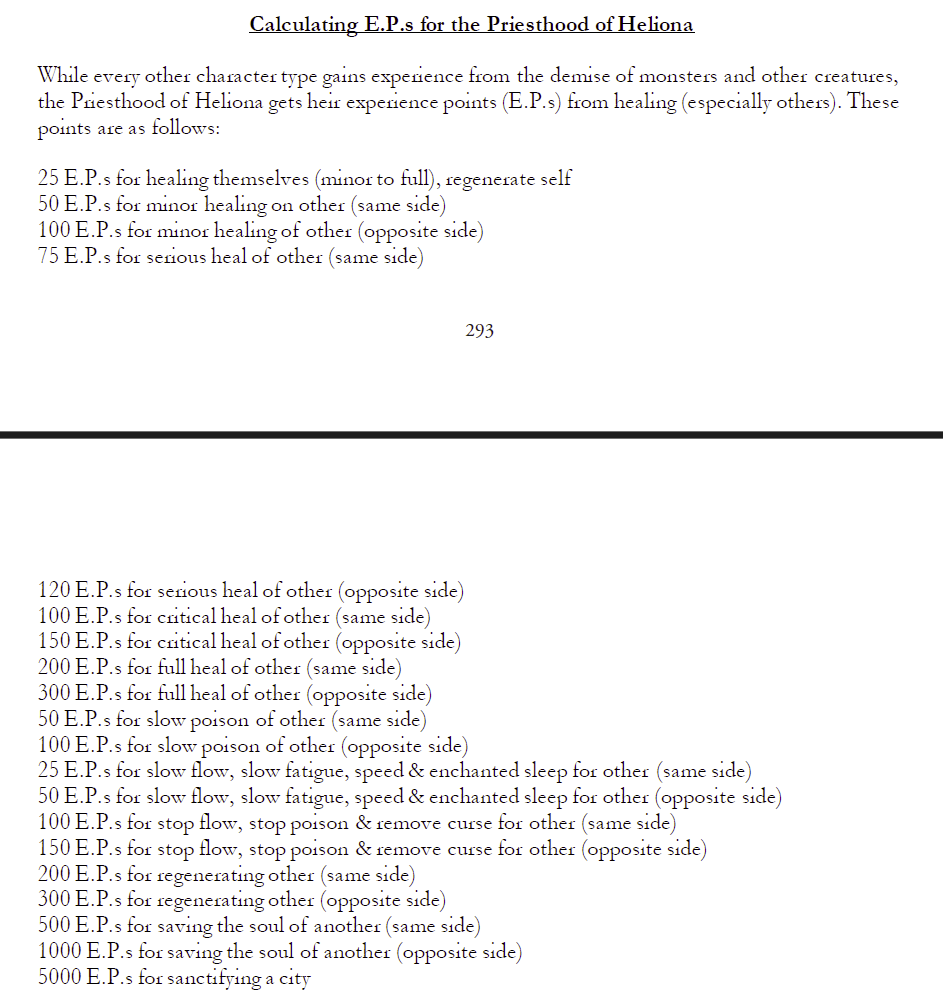
With how much experience you need to hit max level, I’m sure an Atlantasia campaign will last you many years as you painstakingly narrate each and every poor beggar you heal for another hit of those sweet, sweet experience points. I’m not even going to bother describing their spell list, its what you expect.
The Temple of Bahl-inn-orr has a bunch of chores. Every single season you must lead a platoon into battle, take on an apprentice, start your own temple, implement yourself into a foreign temple, and donate 1/4 of your wealth. If you fail, you go down a rank in the temple and lose your top 3 spells. Somehow this is even more disastrous for Priests, because remember, your deity might not even talk to you if you try to cast spells at a low rank.

Presented without context.
There are so many temples. Seriously, I started writing this section thinking it would be a short and sweet distraction, but it just keeps going.
The Temple of Drass-ixx drives a hard bargain. Every season you have to assassinate 3 people, but also hire an assassin? Plus you have to start a temple and donate half your wealth. How do the deities in this setting even function? Surely you’ll run out of people to recruit after a while with this many temples? I bet there’s a fun grift going on where certain people change temples every season so they can claim to have fulfilled the quota.
Anyways, if you fail your chores, there’s a three strike system. Strike 1, gotta kill 2 people for (gasp) free. Strike 2, your family is “forfeited”. Strike 3, you’re dead instantly.
The Temple of Kahlah wants you to reverse 1 act of the Priesthood of Magg-eth, search out and ease the heart of someone with a broken heart, accompany a bard, and donate 1/5 of your earnings. If you fail you lose 3 spells (wow so original) but also you just straight up lose all your money.
Speaking of Magg-eth, its understandable why you’d want to stop them. Their chores include starting 2 wars, breaking up a family, starting a street gang, and raising 15000 gold for the church every single season. Now that’s dedication. Additionally, failing these chores means losing all your spells, and if you don’t make up for it you get kicked out of the temple with a bounty on your head.
The Temple of Prahn-torr cares about law. You have to spend 1 season a year as a judge, and then a police officer, and every year must be spent in a different country. Oh, and you have to give all your money to the temple. ACAB.
If you fuck up here, not only do you lose spells, but you also go to court. If you can’t convince the judge why its okay you missed your chores, you get demoted a rank and must do double chores next year. I assume this is multiplicative with each time you get demoted.
The Temple of Neff-ratti wants you to bring them 3 magic items for the temple, 3 magic items for the Guild House, 1 Artifact for the temple, 1 Artifact for the Guild House, and 1/3 of your cash. What’s funny is the consequences for failing. First offense is giving them more magical items. Second offense is all your magical items. What is the third offense you might ask? You have to commit suicide in front of the entire temple.
The Temple of Psy-nah-moray wants you to learn shit and write books. I’m not gonna type this one out.
The Temple of Gorr-nay-mar is literally the same as the previous one that wanted you to start wars, just with more of a Grima Wormtongue kind of vibe. If you screw up you’re publicly humiliated, until you get strapped to a boulder and fired out of a catapult (not a joke).
For the Brotherhood of the Shaman you have to…. wait. You don’t have to do anything!? You just have to do whatever your Chief asks, but you’re given social status above everyone else. There are no chores, people respect you, you get free shit? Why is any Priest in this world not a Shaman???
Legitimate screencap from the book:

Oh my god, that’s the end of the Priest section. I feel physically unwell after typing all that.
The Magi
Would it shock you to say I actually don’t have anything to say about the Mages? No, seriously.
The Mages are like the Priests, except they have no downsides. They can cast their spells in a single turn. All of their magical orders give them benefits comparable to the Priest’s temples, except they are literally free. You don’t have to kneel down before someone with too many hyphens in their name to get power, you just have these huge spell lists to pick from based on what type of mage you are.
There’s a water mage, fire mage, earth mage, you get the gist. The description is a paragraph long followed by a spell list. The only exception is the Dragon Mage, which is the following:
First, and foremost, you MUST be a master at your own art (a 100th level mage). Next, you must
hunt down an ancient (and it has to be an ancient) dragon to ask if that dragon will teach you. It is
here that you are gambling with your life as there is only a 5% chance this dragon will accept you as
a student (the other 95% of the time you will end up as a snack for the dragon). However, if you are
lucky enough to be accepted, the rewards are beyond your wildest dreams!
By achieving levels in Dragon Mage you can become the furry (scaly?) of your dreams. Each level requires an absurd amount of experience (1 million to 5 million) to reach, and by the end you’ve fused with the dragon.
I really struggle to understand what time scale an Atlantasia campaign is operating on here. It feels like something designed to be the only game you ever play, with how much you have to invest in leveling up a character to 100 MMO-style. Are players expected to roleplay out literally all of these minutia? I can’t imagine combat being shortcut since that seems to be the focus, even when your character is likely to kill themselves by accident. Also, what happened to realism? How did we get here? Where am I? What is this?
The Mindweavers
The Mindweavers are eugenicists. No, seriously:
Mindweavers have the option for 1st attack in any situation (unless they are not being aware of their
surroundings).
There are 3 different families of mindweaver and each has mastered a different discipline. There are
the Brashears: who have mastered the discipline of Protector. There are the Mantherans: who have
mastered the discipline of Healing. And there are the Widdershins: who have mastered the discipline
of Traveling.
While every mindweaver has a telepathic link with each other, no family has ever been able to master
the discipline of Telepathy. As a matter of fact, true telepaths are seen as a “freaks of nature” within
the mindweaver families. These children are shunned from the mindweavers and generally left to
their own in order to survive.
To determine which of the families you come from (mindweaver families arrange marriages due to
which discipline the family line is weakest in), first roll to see which family your father is from (d6)
with the following result:
1 or 4 = Brashear
2 or 5 = Mantheran
3 or 6 = Wallershin
Next roll a d4 for the family your mother comes from (it cannot be the same family as your father so
it has to be one of the other 2 families). Once you have discovered your heritage, the next step is to
discover which is your primary discipline and which is your secondary discipline. Males will follow
their father and females will follow their mother. So, if your father was a Mantheran and your
mother was a Wallershin; and you are playing a female mindweaver; you would be a Traveler/Healer
with the last name of Mantheran (the last name is ALWAYS the father’s last name).
The final thing to do is to roll the % dice (12% chance) to find out if you happen to be one of the
rare ones born a natural true telepath. If this happens, Telepathy becomes your primary discipline
and males will have their father’s discipline, while females will follow their mother’s
So the Mindweavers are psychics, except they hate people who are actually psychic?
These are the pros and cons listed in the book:

The Mindweaver spell list is no different from the Mages, just with a focus on mental shenanigans.
Why are we back on martial classes again?
So after the casters are done, we get some huge exposition dumps on the Guild Houses, which are the evil classes. In summary:
- The Thieves Guild operates in an Inn and have a bounty board. You can specialize in being a cat burglar (goes in through upper windows)(?), pick pocket, or vault specialist.
- The Assassin’s Guild is in a random house in every city and lets you specialize in bladed weapons, distance, and poison.
- The Spies’ Guild is somehow even more secret than the above two and has zero central leadership. Anyone could be a spy, you never know! It is very unclear how you actually become a Spy based on the text here, I guess you kind of just luck into it.
The Miscellaneous Classes
Oh my god. I think I have had a revelation. Holland thinks that the Romani people are the Mongolians. Read the following excerpt and see if this is closer to the cultural stereotype associated with Genghis Khan:
The Gypsies
Gypsies: nomadic horse traders from Matrasq.
Matrasqian steeds are the most coveted horses in the entire Western World and as so come at a very
steep price. And a word of advice, Gypsies are the best traders around. They will not dicker much,
unless you have something they truly want.
Once a rebirth, 2 tribes are given the responsibility of taking the horses no clan wants and traveling
to the rest of Cey-Bra-Lah to get what they can for the horses. The rest of the clans stay behind and
begin to round up and train the next batch of horses. Any outsider; any person not born in Matrasq,
therefore a non-gypsy; attempting to capture a Matrasqian horse will be met by an army of Gypsy
Warriors from all clans, all riding Matrasqian War Horses and gypsies do NOT leave behind
witnesses!
The odd time a Matriarch will send solitary gypsies out on quests, usually to give certain life lessons
to the one sent on the quest. For instance, men who are chosen to be warriors are sent to prove
their worth and learn to survive by their own means which will lead them to be very loyal to their
clan as well as themselves.
I’m not crazy right? Well, I might be. I’ve written this much on a game nobody ever played or bought for $45 retail. The Gypsy class specializes in doing things that are racially associated with the Romani, including palm reading, appraising jewels/gems, and *sigh* pickpocketing. Also they appraise horses. I really don’t want to talk about this.
Next up is the Bard, which contrary to how other modern RPGs typically present the class, this one is literally just a person who knows how to play an instrument. They’re charismatic, can play music, and can make money by combining both of those things. There’s nothing more to them than that.
The final class is the Noble. You have money, that’s the class.
How to Run a Successful Atlantasia Campaign
Oh my god. We’re here. It’s the end of the book. In a manner befitting this complete! tome, the final section is titled “Tips on Running a Successful Campaign”. This is it folks, all our questions will be answered here. How do we make combat work? Why are Priests so bad? What’s with all the culturally insensitive aspects to the text? What happened to Appendix 1 which supposedly contains a sample adventure but is not actually in the book?
Here. We. Go.
There are a few things you, as the Game Master, should know about Atlantasia in order to give you
(and especially the players) the best experience possible while running through a campaign.
First, and foremost, the supplemental books (some which are available or soon will be) will assist
you in helping your players (and you) into a fuller understanding of the world (and other
dimensions) which they will be traveling through. I would strongly advise to obtain the atlases as
they give you not only the maps of the countries, but maps of all the main cities as well as a
complete description of the terrain, the population, the type of people who live there (including
descriptions of their looks) and a history of the country.
Other books that will assist greatly (so keep an eye out for these ones) are:
- The Tome of Dimensions;
- The List of Traps & Wards;
- The Book of Ancient Spells;
- The 3 Dictionaries (High Elven, Dwarven & Gnomish);
- Poisons of Atlantasia;
- The Advanced Apothecary;
- Advanced Weaponry; and, of course,
- The Eastern Realms
There will be others that are still in the works and we will let everyone know when they are near
ready on J.A.C.H. Book’s website.
While these books will greatly enhance everyone’s experience on Atlantasia, you can still run a very
good campaign. However, there are a few areas of Atlantasia that you will need to know about (and
how things work in those areas).
I can’t believe it. To run an Atlantasia campaign, I need all these other books that never came out? Have we been scammed? Well, no, because Hollland was gracious enough to include two more small sections here describing two location in Atlantasia.
First is Baba-Luna:


How does this help me run a successful campaign? This is worldbuilding! What am I supposed to do as a GM running this game??

ONCE AGAIN? HOW DOES THIS HELP ME RUN A CAMPAIGN? CAN I HAVE A CRUMB OF GAME MASTER ADVICE PLEASE?
Other things to keep in mind when running a campaign is the size, levels and abilities of the group.
When rolling for encounters, the number involved in the encounter can be adjusted to fit the size,
levels and abilities of the group (ie: you would not want to send a high level group against a measly
36 goblins, rather increase the number of goblins so that it gives the group a challenge to stay alive).
If a group (especially a low level group) runs across a dragon hunting, it IS up to them if they wish
to stay and attack but that would almost definitely be the end of that group.
The main thing in this game is to make the players think before they react and to try and ensure they
have fun doing it. For every action done on Atlantasia, there is consequences (whether good or bad)
so use your own judgment (ie: if a guild member is to enter a city and not get in contact with their
guild to ask permission to ply their trade, there is a good chance they will be either thrown out of the
city without anything but the clothes on their backs or plainly executed ).
Happy adventuring and guiding your friends through many, many travels (there is a whole world out
there awaiting to be discovered)!
That’s it…. that’s how the book ends. Two pieces of advice, increase the number of goblins your players fight if they’re strong, and also actions have consequences.
I’m numb.
Closing: The Goblin that Bit Itself to Death
Why did I write all this?
The Realms of Atlantasia has haunted me ever since it first appeared in my downloads folder. Whenever I’m writing any kind of longform content, I think about this game. I ask “Who am I writing this for? Is this for my own enjoyment, or for my players? Is this something someone actually wants to play?” I think that helps grounds things.
John Holland set out to make the perfect game for himself. Through years of running early D&D, he had an idea of what he wanted to see in an RPG and finally chose to consign it to paper. It contains hundreds of pages of numbers, tables, spells, and worldbuilding, with ambitious plans for more to follow. I don’t know if he ever stopped to think whether any of it was good or not. It was what he wanted, isn’t that enough?
To all the RPG writers out there, I wish you luck on your endeavors. I hope you create something which appeals to you, and that you can find someone, anyone, who can share that interest with you.
If you want to read the Realms of Atlantasia, you can easily find a PDF on Google by typing “realms of atlantasia pdf”. It’s probably on 4plebs or something. You could also buy the book, there’s supposedly copies on Amazon, though it may or may not be a scam. You’re probably better off not knowing.
Thanks for reading my random bullshit train of thought. I pass this curse onto you now. Let me know what you think in the comments.
 Thinking about Games